
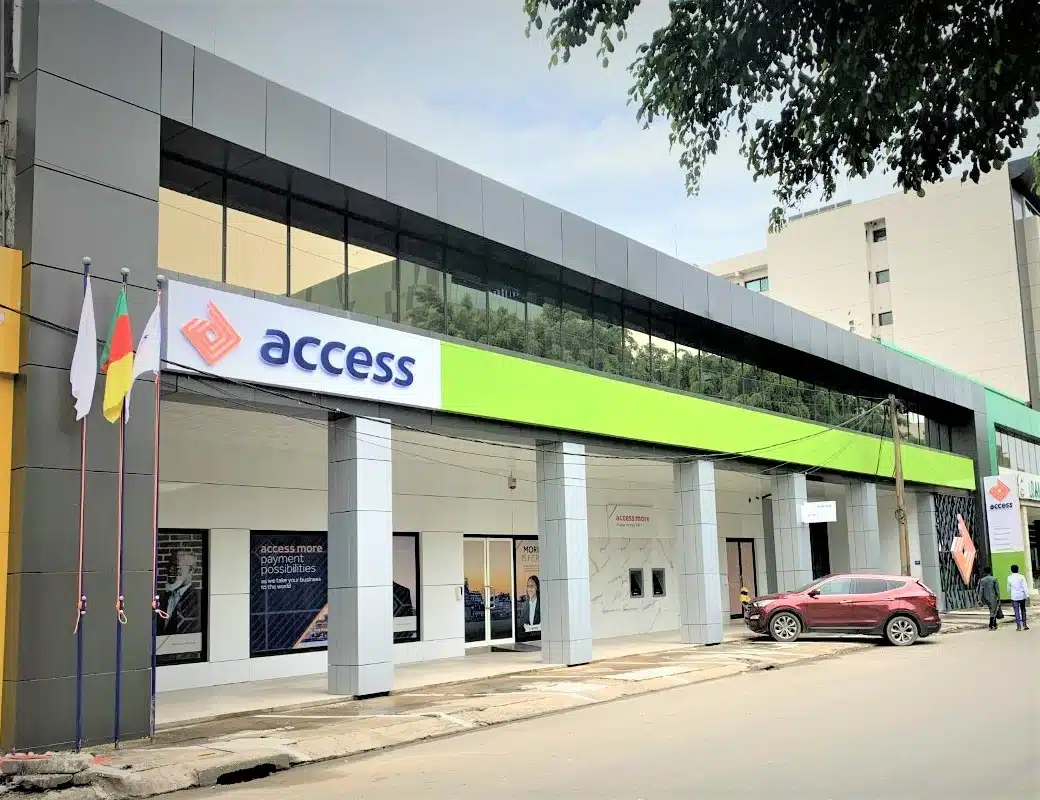


Access Bank Nigeria was the only African subsidiary of Access Holdings Plc to record a drop in earnings in the first half of 2025, even as the group’s other markets delivered strong performances and deepened the bank’s ongoing shift away from reliance on its home country.
A Finance in Africa analysis of the group’s half-year financials shows that while Access Nigeria’s profits plunged, its African peers—from Ghana to Rwanda and Mozambique—posted robust growth, helping rebalance the group’s earnings base.
This divergence forms the core of Access Holdings’ changing story: Nigeria, once the profit engine contributing more than 50% of group earnings, is now ceding ground to the rest of Africa.
Nigeria’s sharp decline
Access Bank Nigeria, the group’s flagship and largest subsidiary, reported a 30.7% drop in after-tax profit to ₦114.5 billion ($73.82 million) in H1 2025, down from ₦165.2 billion ($109.9 million) a year earlier.
It was the steepest decline across Access Holdings’ 15 African subsidiaries. Compared to H1 2023, Nigeria has a profit growth of 62.1%.
Much of the record profits posted by Nigerian banks—including Access—in 2023 and 2024 were driven by government reforms that triggered two major naira devaluations, in June 2023 and January 2024, as well as higher interest income as a result of the Central Bank of Nigeria’s aggressive monetary tightening.
From July 2023 to November 2024, the Monetary Policy Rate (MPR) has risen by 875 basis points to 27.50%, creating an exceptionally high-yield environment that turbocharged bank margins.
But that cycle peaked. In July this year, the CBN held the MPR steady at 27.50% for a third consecutive meeting before cutting it by 50 basis points to 27% in September—its first rate reduction in five years.
Last Tuesday, the apex bank maintained the rate at 27%. The shift marked the beginning of a moderation in the high-interest environment that had previously buoyed Access Nigeria’s income.
These dynamics, combined with weaker fair value gains and a more challenging operating environment, contributed to the steep decline in Nigeria’s earnings.
The group said in its latest investor relations report that the downturn “reflects the impact of higher impairment charges and lower fair value gains.”
Analysts at Coronation Research added that interest expense jumped 10.5% year-on-year to ₦1.06 trillion ($683.0 million), driven by deposit repricing and higher wholesale borrowing costs.
“Additionally, loan impairment charges climbed sharply, reflecting increased provisioning likely linked to the exit of regulatory forbearance positions,” they said.
The slump in Nigeria’s numbers also pulled down group performance: It reported a 23.3% decline in after-tax profit to ₦215.9 billion ($139.1 million), marking its first half-year profit contraction since 2020.

Nigeria’s shrinking share of the pie
The results highlight a structural shift in the group’s earnings mix. Nigeria’s share of group pretax profits fell to 37% in H1 2025, down from 62% in the same period of 2023. Meanwhile, the contribution from the rest of Africa surged to 37%, up from 19%, nearly matching Nigeria for the first time.
The United Kingdom subsidiary, launched in 2008, also recorded a moderate decline, with profit falling 10.8% to ₦73.5 billion ($47.4 million). But the UK downturn was offset by strong continental performance.
Africa delivers: Broad-based growth
Across sub-Saharan Africa, Access subsidiaries reported broad earnings expansion, underscoring the group’s diversification strategy and its growing foothold in high-potential markets.
Subsidiaries in Ghana, the Democratic Republic of Congo, Rwanda, Zambia, Gambia, Sierra Leone, Guinea, Botswana, Cameroon, Angola, and Tanzania collectively delivered ₦110.5 billion ($71.2 million) in profit, up from ₦73.6 billion ($48.9 million) in H1 2024.
Standout performers included:
- Tanzania, posting a 1,302% surge to ₦659 million ($424,640), supported by improved asset quality and cost discipline.
- Sierra Leone, with 231.3% growth.
- Ghana and DRC, which continued to serve as stable growth pillars.
Meanwhile, previously loss-making markets posted a turnaround. Mozambique, Kenya, and South Africa—which recorded a combined loss of ₦9.87 billion ($6.67 million) last year—swung to a combined ₦16.9 billion ($10.9 million) profit in H1, driven by stabilising currency conditions and operational restructuring.
Competitive context: Access outperforms GTCO’s African network
Access Holdings’ continental gains stand in contrast to Guaranty Trust Holding Company (GTCO), which saw half of its ten African subsidiaries record profit declines in the first half of the year due to rising inflation and cost pressures across key markets.
In 2024, all GTCO subsidiaries delivered growth, highlighting how rapidly the operating landscape has shifted.
Access now operates in 16 countries with more than 700 branches and service outlets. It is the second-most geographically diversified Nigerian bank after United Bank for Africa (UBA), which has 20 subsidiaries.
Last October, the group announced that it would pay $109.6 million (₦179.1 billion) to complete its acquisition of National Bank of Kenya (NBK) from KCB Group. The deal will give the company full ownership of NBK and marks its second acquisition in Kenya, following the takeover and rebranding of Transnational Bank in 2020.
A strategy paying off — but with risks at home
Taken together, the results show a banking group increasingly cushioned against Nigeria’s macroeconomic volatility. Access Holdings’ African expansion is paying off, creating new revenue pools and reducing concentration risks.
But the numbers also highlight growing vulnerabilities in its home market, where high impairments, compressed margins, inconsistent foreign exchange liquidity, and regulatory tightening continue to weigh on performance.
For now, one trend is unmistakable: Access Bank Nigeria is no longer the dominant force in the group’s earnings story — Africa is rising fast to take its place.
Note: All figures were converted at the official average exchange rate of ₦1,551.9/$1 for H1 2025 and ₦1,503/$1 for H1 2024.