
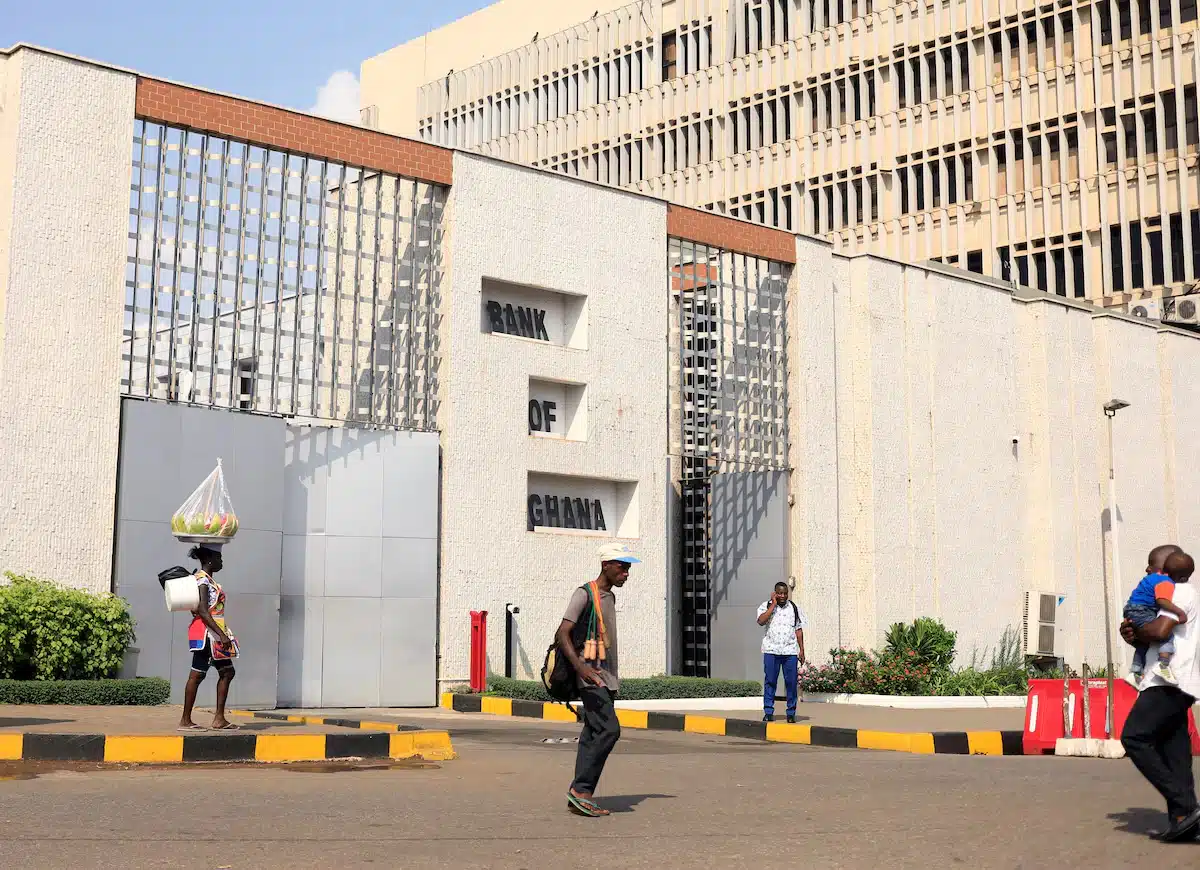


Ghana’s central bank cut its benchmark interest rate by 250 basis points to 15.50% in its first monetary policy action for 2026, citing sharply lower inflation, stronger foreign reserves and improved macroeconomic stability.
The decision, reached at the conclusion of its 128th Monetary Policy Committee meeting on Wednesday, marks the fourth consecutive reduction, following faster-than-expected easing of inflationary pressures in 2025.
Headline inflation decelerated to 5.4% in December 2025 from 23.8% a year earlier, a dip the central bank attributed to restrictive monetary policy, lower fiscal deficits and a strengthening currency.
“The disinflation process was broad-based and supported by tight monetary policy, fiscal consolidation, and currency appreciation,” the Bank of Ghana said in its policy statement, adding that inflation expectations across key segments of the economy remain well anchored.
According to the statement, the central bank’s core inflation measure, which excludes energy and utility prices, also moderated during the year, signalling muted domestic inflation risks.
Liquidity tightness eases
Monetary growth slowed sharply as the bank maintained a tight stance through most of 2025. Reserve money expanded by 12.5%, down from 47.8% in 2024, reflecting increased sterilisation. Broad money growth also fell to 16.5% from 31.9%.
The easing cycle has filtered through financial markets.
The 91-day Treasury bill rate dropped to 11.08% in December from 27.73% a year earlier. Average lending rates declined to 20.45% from 30.2%, helping private-sector credit growth rebound to 13.1% from 2.0 % in 2024.
The central bank said the earlier 900bps of cumulative easing during the year helped restore credit flows without reigniting inflationary pressures.
Fiscal consolidation supports policy shift
Improved fiscal discipline reinforced the case for a rate cut.
The overall fiscal deficit stood at 0.5% of Gross Domestic Product by November, well below the 3.5% target. The primary balance recorded a surplus of 2.8% of GDP, while public debt declined to 45.5% from 63.1% a year earlier.
External buffers strengthen
The external sector continues to deliver a strong performance.
Gross international reserves rose to $13.8 billion at the end of last year, equivalent to 5.7 months of import cover, from $9.1 billion at end-2024. The reserve build-up supported the cedi, which appreciated by 40.7 % against the US dollar during the year after a sharp depreciation the previous year.
The MPC said inflation is expected to remain within the medium-term target of 5-8%, although risks persist from utility price adjustments, commodity volatility and geopolitical tensions.
The bank will continue to closely monitor domestic and global conditions as it seeks to preserve hard-won macroeconomic stability.
Its next MPC meeting is scheduled for March 16-18.