
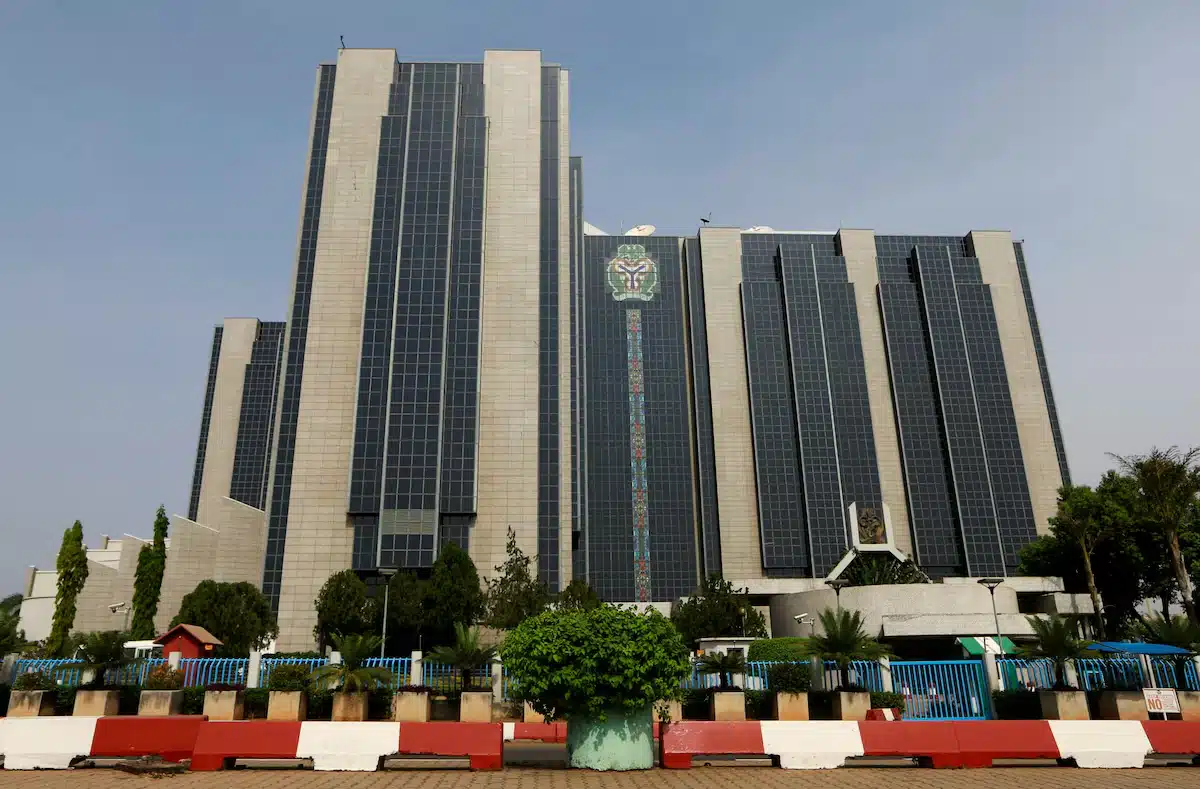


The Central Bank of Nigeria (CBN) has reduced its Monetary Policy Rate (MPR) by 50 basis points to 26.5% from 27%, marking the first rate cut in the new year and signalling a cautious shift toward supporting economic growth amid sustained disinflation and improved macroeconomic stability.
The decision was announced at the end of the 304th Monetary Policy Committee (MPC) meeting held on February 23-24, 2026, in Abuja. The committee, with 11 members in attendance, voted to ease the benchmark rate while holding other key parameters steady.
In his post-meeting press briefing on Tuesday afternoon, Governor Olayemi Cardoso explained the rationale behind the move. He highlighted that the MPC’s decision reflects growing confidence in the disinflation process, with headline inflation easing to 15.10% in January 2026 from 15.15% in December 2025, driven largely by moderating food prices and core components.
Cardoso noted that this marks continued progress from the peak levels seen in prior years, supported by reforms including foreign exchange unification, fiscal coordination, and strengthened external reserves.
The governor emphasized that the modest 50 basis point adjustment is data-driven and balanced, aimed at gradually lowering borrowing costs to stimulate real sector activity and investment without risking a reversal in inflation gains.
He reiterated the CBN’s commitment to remaining vigilant against potential pressures, including those from election-related spending in 2026, which could introduce liquidity risks if not managed carefully. Cardoso urged fiscal authorities and stakeholders to maintain discipline to preserve the hard-won macroeconomic stability.
He also addressed the retention of tight liquidity measures, stating that the high Cash Reserve Ratio (CRR) and asymmetric Standing Facilities Corridor continue to play a crucial role in anchoring expectations and preventing excess liquidity from fueling inflationary pressures.
Key policy decisions
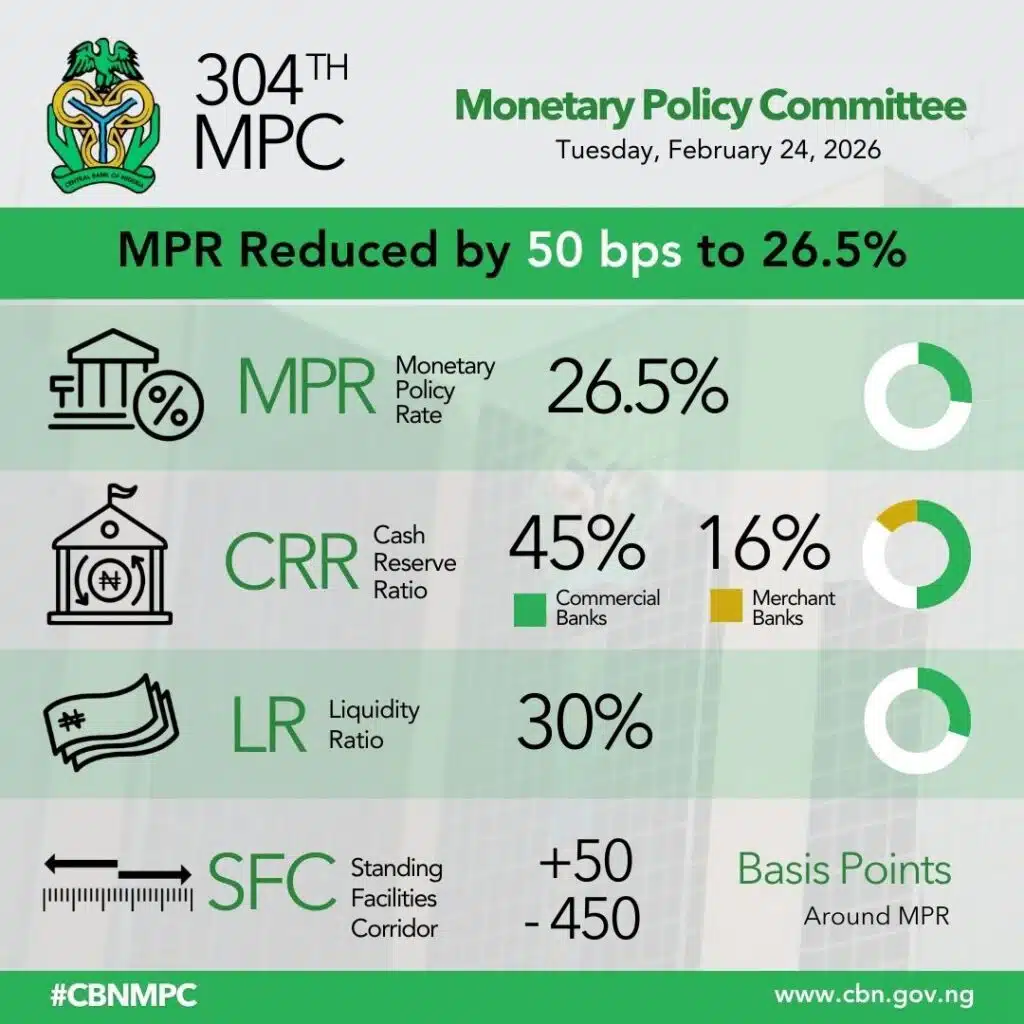
- Monetary Policy Rate (MPR)**: Reduced by 50 basis points to 26.5% from 27%.
- Cash Reserve Ratio (CRR): Retained at 45% for commercial banks and 16% for merchant banks.
- Liquidity Ratio (LR): Retained at 30%.
- Standing Facilities Corridor: Retained at +50/-450 basis points around the MPR.
The MPC’s choice to maintain the asymmetric corridor, CRR, and LR reflects a measured approach, preserving tight liquidity controls on banks while allowing the modest rate reduction to begin transmitting lower borrowing costs to the broader economy.
Context and drivers.
The rate cut follows a prolonged period of tightening that saw the MPR peak at 27.5% in late 2024 before stabilizing at 27% through much of 2025. Recent data has shown headline inflation trending downward for several consecutive months, reaching 15.10% in January 2026.
This disinflation, combined with naira stability in the foreign exchange market, stronger external reserves, and improved investor confidence, provided the committee room to pivot slightly toward growth support.
Analysts had widely anticipated a 50 basis point cut, citing easing price pressures, a firmer naira, and the need to ease financing costs for businesses and households without undermining ongoing efforts to anchor inflation expectations.
The move is seen as a balanced response; it acknowledges progress in stabilising the economy under reforms like FX unification and fiscal coordination, while retaining restrictive elements (high CRR and asymmetric corridor) to guard against potential reversals from external shocks, fiscal spending pressures ahead of future political cycles, or renewed inflationary impulses.
Market and economic implications.
Lower MPR should gradually translate into reduced lending rates, cheaper credit for the real sector, and potential stimulus for investment and consumption. It also aligns with the positive sentiment in Nigeria’s capital markets, where foreign portfolio inflows have surged in recent periods.
However, the 50 bps adjustment is modest, indicating the CBN remains vigilant. The retained high CRR continues to mop up excess liquidity, helping contain inflationary risks from any demand surge.
This decision positions Nigeria’s monetary policy at a turning point shifting from aggressive tightening to a more neutral stance while the economy continues to benefit from structural reforms. Investors and businesses will closely watch upcoming inflation prints, FX flows, and future MPC communications for clues on the pace of further easing.
The CBN emphasised that future decisions will remain data-driven, with the next MPC meeting expected later in the year.