
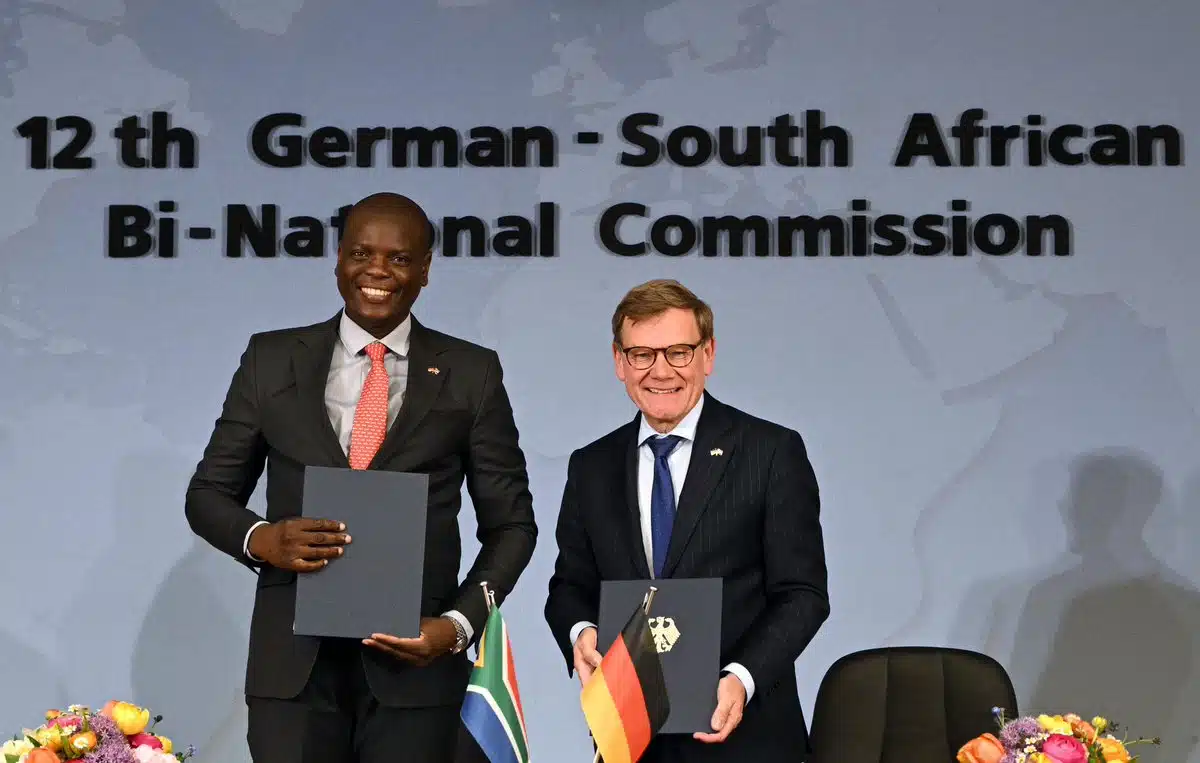


Germany has pledged a €200 million ($234 million) concessional climate loan to South Africa to modernise its power grid and accelerate renewable energy deployment, officials announced Monday.
The funding, discussed during South African Foreign Minister Ronald Lamola’s visit to Berlin, includes over €270 million in additional German and EU support for green hydrogen projects, battery value chains and critical minerals cooperation. The countries formalised the expanded partnership through a new action plan.
South Africa continues to grapple with unreliable electricity supply and an ageing coal fleet that dominates its power mix. The concessional loan aims to de-risk transmission upgrades, a major bottleneck and unlock stalled renewable projects.“Germany is a reliable partner,” Lamola said, thanking Berlin for its backing amid strained ties with the United States under President Trump’s second term.
Strategic shift amid geopolitical tensions
The announcement comes as Washington has distanced itself from Pretoria, criticising its policies and reducing engagement in forums like the G20. European partners see an opening to secure African supplies of platinum-group metals, manganese and other minerals vital for electric vehicles and hydrogen technologies.
The additional funding builds on Germany’s Just Energy Transition Partnership (JETP) commitments, emphasising local processing and supply chain development rather than raw exports.
Markets angle: catalytic but modest support
At roughly €470 million combined, the package is relatively small against South Africa’s vast energy needs but carries high signalling value. It adds to prior JETP disbursements and could attract private capital by improving grid reliability and derisking green projects.
Proceeds are expected to channel through institutions like KfW to Eskom or independent power producers. Investors are watching for faster implementation this time, as past tranches have faced delays amid domestic politics and union resistance.
For global markets, the deal positions South Africa as a potential hub for green hydrogen and battery materials, aligning with Europe’s push to diversify away from dominant suppliers while meeting carbon targets.
Risks persist, including execution challenges and coal-dependent constituencies. Still, the German commitment underscores Europe’s willingness to fund reliable African partners in the global energy transition.