
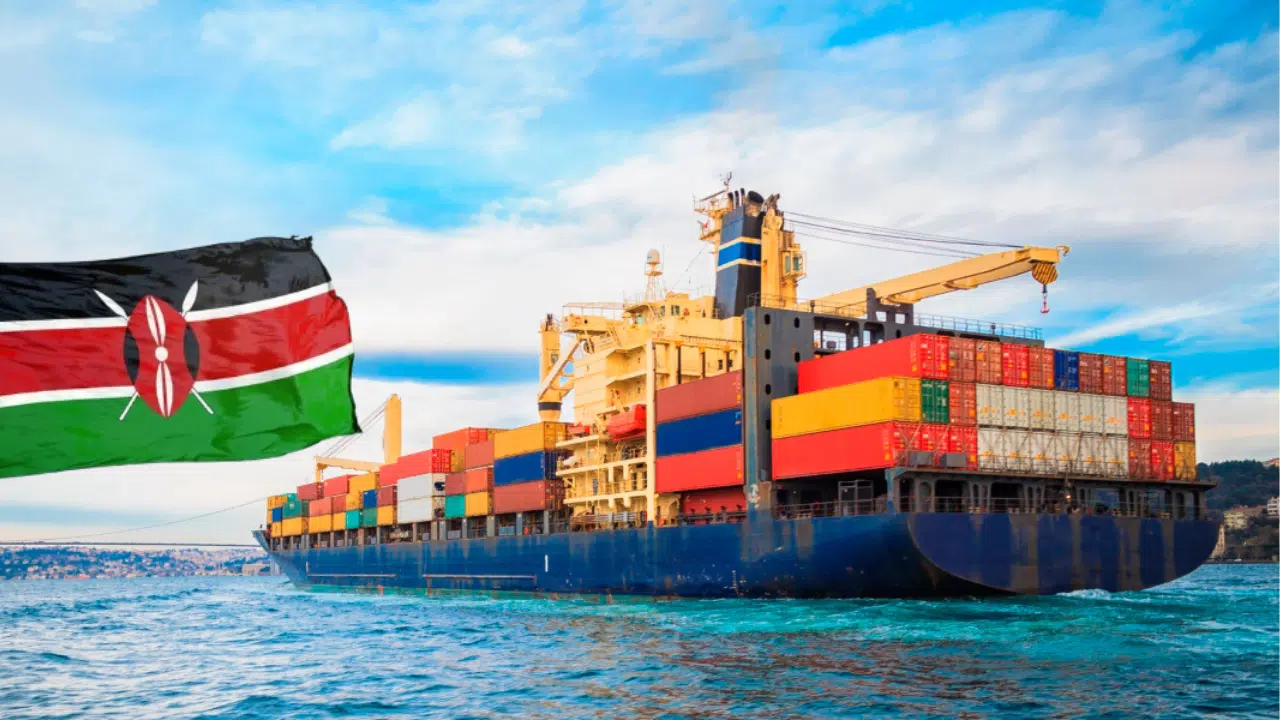


Kenya has reached a preliminary agreement with China granting tariff-free access to 98.2% of locally produced goods, as authorities move to lift foreign earnings.
The deal, announced on Thursday by the Ministry of Trade, comes as East Africa’s largest economy grapples with a widening trade deficit.
According to the latest Balance of Payments report from the Kenya National Bureau of Statistics, the country’s trade shortfall topped $9.3 billion (KSh1.2 trillion) in the first nine months of 2025, widening by about $400 million (KSh50 billion) compared with the same period in 2024.
More important than the year-on-year increase is the scale of the imbalance, highlighting Kenya’s heavy reliance on imported goods.
A closer look at the data shows total imports climbed to $16.3 billion (KSh2.1 trillion) between January and September, up from $15.5 billion (KSh2.0 trillion) a year earlier, while revenue from exports slipped to $6.5 billion (KSh846.1 billion), down from $6.6 billion (KSh855.0 billion).
Technically known as an Early Harvest Arrangement, the preliminary deal will allow Kenyan shipments duty-free entry into China while negotiations on a full trade agreement are finalised.
Officials say the move could unlock “vast economic potential” for the coffee-producing nation by boosting export diversification, particularly in agriculture.
“This development is expected to generate considerable employment opportunities and bring tangible benefits to our economy,” the trade ministry said in a statement.
Agriculture remains the mainstay of the East African economy, with food and beverages consistently accounting for the largest share of foreign earnings.
In the third quarter of 2025 alone, the sector contributed over 43% of the $2.2 billion (KSh289.4 billion) earned from international markets.
Rising imports from China widens trade deficit
Bilateral trade between Kenya and China has expanded rapidly over the past two decades, reaching about $4.7 billion in 2024, up from $3.8 billion in 2023.
Kenya’s major exports to the Asian economy include tea, coffee, and scrap metal, while textiles, electronics, and construction machinery dominate its import bill.
Despite expanding commercial ties, Nairobi continues to record a large deficit in favour of Beijing.
During the review period, the import spend on Chinese goods rose 14.5% year-on-year to $3.8 billion (KSh488.9 billion), while outbound earnings fell to $103 million (KSh13.3 billion), leaving about a $3.7 million (KSh475.6 billion) shortfall.
The new arrangement represents Kenya’s latest effort to rebalance trade by providing exporters with greater access to China’s $19 trillion economy.
With almost all locally produced goods now enjoying preferential treatment, businesses can expand their market base, strengthen margins, and boost foreign exchange inflows.
As Kenya’s largest trading partner, renewed demand from Beijing could help lift receipts from overseas markets and narrow the overall trade deficit.
US trade stagnates
Kenya’s flows into the US — another key market — fell to $465.1 million (KSh59.9 billion) in the first nine months of 2025 from $508.5 million (KSh65.5 billion) a year earlier, reflecting subdued demand following Washington’s tariff hikes.
Under President Donald Trump’s revived “America First” agenda, a 10% import duty was imposed on Kenyan goods effective August 7, 2025, as part of efforts by the US to reduce bilateral imbalances.
Although the levy was among the lowest applied to African exporters and came into force late in the review period, demand from US buyers softened, leaving total trade muted at $1.3 billion (KSh179.2 billion).
By contrast, South Africa’s trade with the US remained resilient despite facing the continent’s steepest tariff of 30% on all America-bound shipments, alongside sector-specific levies.
Data from the US Census Board shows US imports from South Africa rose sharply to $14.6 billion between January and October 2025, up from $11.3 billion a year earlier.
Despite the downturn in trade with the US, Kenya is pushing ahead with efforts to strengthen ties with Washington, with authorities confirming that negotiations on a separate bilateral trade accord are ongoing. How this will shape Nairobi’s deepening engagement with China remains to be seen.
Africa remains Kenya’s largest export market
As demand from China and the US waned, African markets absorbed a larger share of Kenya’s exports, with shipments rising to $2.6 billion (KSh336.7 billion) in the first nine months of the year — nearly 40% of total foreign earnings.
The figure marks a 4.1% year-on-year increase that lifted Nairobi’s trade surplus with the rest of the continent to nearing $1 billion (KSh121.7 billion) as imports stood at $1.7 billion (KSh215.0 billion).
Momentum strengthened in Q3, with intra-African exports expanding by 15.3% compared to the previous year, accounting for 44.6% of total receipts and reinforcing Africa’s position as Kenya’s largest export destination.
The quarterly improvement was underpinned by higher FX inflows from Egypt, Uganda, the Democratic Republic of Congo and Rwanda.
“Conversely, export earnings from Sudan, South Sudan and Somalia fell by 92.1%, 26.1% and 21.7%, respectively, during the quarter,” the BoP report said.
The European Union followed closely, with earnings from the bloc rising to $1.57 billion (KSh202.2 billion) between January and September last year, up from $1.5 billion (KSh193.4 billion) in 2024.
China strengthens Africa ties amid global trade tensions
China’s latest trade concession to Kenya reflects a broader push to deepen economic ties with African allies as global uncertainties deepen.
The shift follows Beijing’s pledge last June to eliminate tariffs on imports from 53 African countries, announced in the wake of Trump’s renewed tariff offensive.
Implementation is already underway. In October, China granted Ghanaian tariff-free access to its economy, with Kenya now the latest major African economy to secure similar terms.
Beyond import duties, China is also seeking to expand its influence in East Africa through investments in key shipping lanes and trade routes, offering alternatives to corridors traditionally dominated by Western powers.
Foreign minister Wang Yi’s scheduled visit to Ethiopia, Somalia, Tanzania, and Lesotho during his ongoing New Year diplomatic tour underscores this growing interest.
Taken together, these steps position China as a champion of open trade and a reliable partner at a time when US–Africa relations remain strained by rising protectionism.