
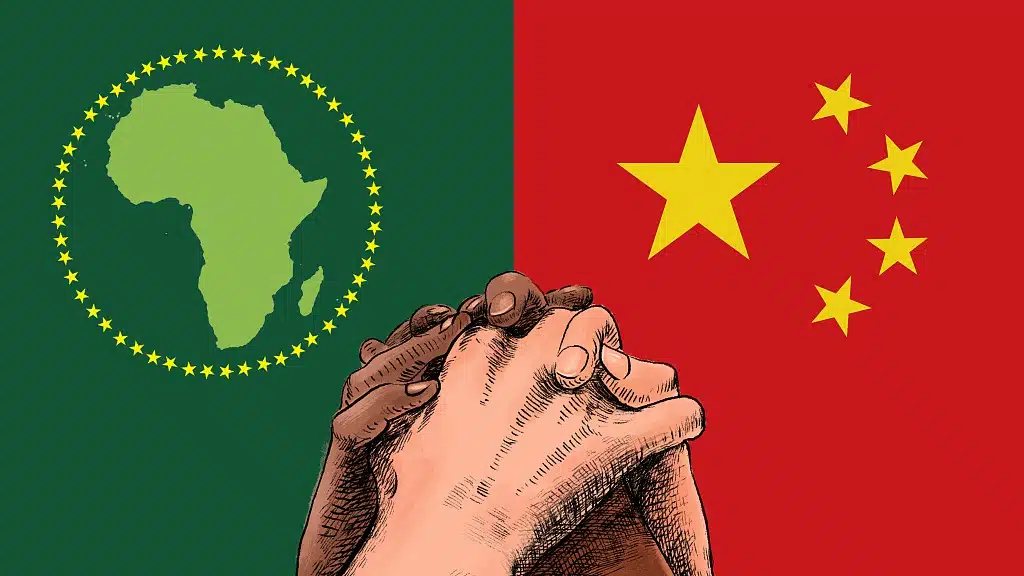


Over the past decade, China’s lending to Africa has plummeted, with annual commitments falling below $5 billion since 2020, after consistently exceeding $10 billion between 2012 and 2018.
New data from the Boston University Global Development Policy Centre shows that Chinese loan disbursements declined further to $2.1 billion in 2024, following a mild rebound to $3.9 billion in 2023. This marks a sharp contraction from the $28.2 billion peak recorded in 2016.
The pullback reflects a broader shift in Beijing’s external economic strategy, as the world’s second-largest economy moves away from development lending for large-scale infrastructure projects towards more selective engagement through trade, foreign direct investment (FDI) and strategic partnerships.
In 2024, Chinese banks financed just six projects across Africa, focusing on a narrower group of borrowers and lower-risk sectors such as energy, transportation and financial services.
Angola emerged as the largest recipient, securing $1.45 billion for electricity transmission and road projects.
Another notable shift was China’s increased deployment of yuan-denominated loans during the year, reflecting a departure from the dollar-based financing that dominated earlier lending cycles.
The Boston University Global Development Policy Center is a research hub that maintains the Chinese Loans to Africa database, an interactive project tracking loan commitments by Chinese creditors to African governments and state-owned enterprises.
The database is updated periodically as new data becomes available.
A narrower pool of borrowers
Only five African countries — Angola, Kenya, the Democratic Republic of the Congo (DRC), Senegal and Egypt — received Chinese loans in 2024.
This shrinking pool reflects Beijing’s pivot towards a tighter group of borrowers with “established relationships, deeper markets and clearer profit potential,” the report noted.
Angola, Kenya and Egypt ranked among Africa’s largest historical debtors, together accounting for more than one-third of all Chinese lending to the continent between 2000 and 2024.
These long-standing ties appear to have sustained their access to Chinese financing in 2024, despite elevated sovereign default risks.
“This demonstrates the importance of relationship continuity and patient capital: creditors have stronger incentives to maintain engagement and provide flexibility for established borrowers even amid fiscal challenges, even if it means exposure to heightened repayment risk,” the report said.
Uneven lending patterns
Lending remained highly concentrated in 2024, with Angola alone accounting for the bulk of the $2.1 billion in Chinese loan commitments.
The southern African oil producer received $1.45 billion, representing the largest single share of Chinese disbursements for the year. Of this amount, $760 million was allocated to a transmission line project in Luachimo, while $690 million financed a large-scale infrastructure development project off the coast of Luanda, covering real estate, highways, ports and a marina.
Kenya followed with $227.8 million for spot improvements along the Nghonji–Lake Jipe Road in Taita Taveta County, while the DRC secured $240 million to complete the 63-kilometre Kinshasa ring road project. All infrastructure loans secured by Kenya in 2024 were yuan-denominated.
Meanwhile, the Export-Import Bank of China extended an $85 million credit line to Senegal for rural well drilling, while Egypt received $76.5 million to support small and medium-sized enterprises (SMEs).
Notably, no individual project exceeded $1 billion in value, underscoring China’s continued retreat from mega-scale development financing in Africa and its growing preference for smaller, targeted interventions.
ICT, trade and industry lose out
As China tightened its lending focus towards less risky segments of the economy, financing for sectors such as trade, industry, services and information and communication technology (ICT) dried up in 2024.
According to the report, China’s loan commitments to Africa during the year were confined to just four sectors — transportation, energy, water, sanitation and waste management, and financial services — all of which have historically attracted the largest shares of Chinese lending.
No debt-financed projects were recorded across any other sector, highlighting the extent of the contraction in Beijing’s development finance footprint. However, ICT saw a sharp rise in equity investments between 2023 and 2024.
The authors cautioned that broader pivot does not necessarily signal a renewed strategic prioritisation of the focus sectors. Instead, it reflects their relative resilience in securing debt financing even as China’s overall lending continues to shrink.
“Such sectors remain loan-resilient because they are less easily substituted by equity investment,” the report noted.
Strategic investments and yuan-denominated loans
The latest data shows China remains committed to engaging with African economies, but with greater focus on targeted FDI and alternative financing models.
According to the report, Angola secured $350 million from Chinese investors in Q3 2025 alone, to boost soybeans production and exports.
A similar pattern is emerging in Egypt, where FDI has risen sharply since 2022, spanning strategic sectors such as manufacturing, energy, and materials processing, signalling a shift towards projects with clearer commercial returns and trade linkages.
At the same time, Beijing is increasingly turning to RMB-denominated loans as an alternative to traditional dollar-based sovereign lending.
The move towards yuan financing and refinancing — illustrated by recent arrangements with Kenya — offers potential advantages, including lower interest costs and reduced exposure to dollar liquidity pressures.
However, analysts caution that currency risks remain if borrowers are unable to build sufficient RMB reserves through trade or other channels to service their obligations.
New priorities
Looking ahead, observers expect China’s recalibrated engagement with Africa to persist.
“As the era of billion-dollar projects winds down, China’s evolving financial instruments may define a new, more selective phase of engagement,” the report said.
Whether this new model can sustain the depth of China–Africa economic relations remains uncertain, particularly as overall lending volumes continue to shrink and engagement becomes increasingly driven by commercial, rather than developmental, priorities.