
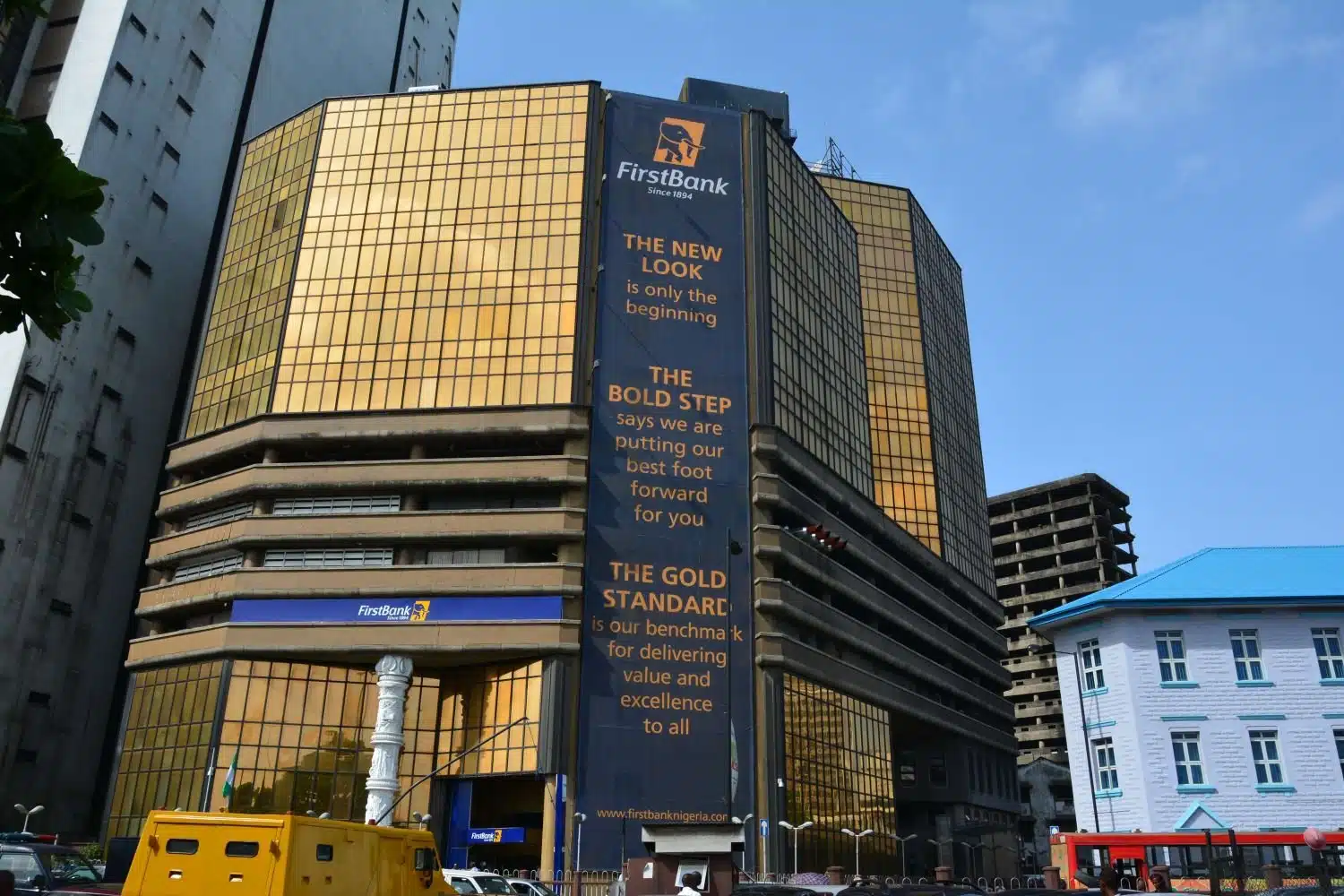


First HoldCo Plc’s 2025 financial results delivered a sharp message to shareholders: while the group’s income engine remained intact, earnings attributable to each share collapsed under the weight of heavy credit-loss provisioning and losses from discontinued operations.
The holding company, which controls First Bank of Nigeria, reported earnings per share (EPS) of ₦1.09 in 2025, down from ₦18.21 in 2024, following a 93% year-on-year drop in profit after tax to ₦44.98 billion ($29.6 million), from ₦677 billion ($444.8 million) in 2024. The scale of the EPS decline — rather than topline performance — has emerged as the most striking feature of the results.
According to the group’s financial statements, two factors were overwhelmingly responsible for the earnings hit: a ₦748.1 billion ($491.5 million) impairment charge for credit losses and losses linked to the divestment of its merchant banking unit.
Two clear drivers behind the earnings collapse
First, the group took a ₦748.1 billion ($491.5 million) impairment charge, a 75.5% increase from the prior year. The provisioning surge wiped out a large portion of operating income, compressing profit available to shareholders despite strong growth in interest earnings.
Gross interest income rose 23.6% to ₦2.96 trillion ($1.95 billion), while net interest income climbed 36.3% to ₦1.91 trillion ($1.25 billion), reflecting higher yields and balance sheet expansion. But the impairment charge more than absorbed those gains, leaving only a thin residual profit.
Second, First HoldCo recorded losses from discontinued operations following the sale of FBNQuest Merchant Bank Limited, which was finalised in September 2025. The transaction resulted in a ₦16.9 billion ($11.1 million) loss at group level, and discontinued operations swung from profit in 2024 to a ₦7.8 billion ($5.1 million) loss in 2025, further reducing earnings attributable to shareholders.
Together, these two items explain why profit for the year fell from ₦677 billion ($444.8 million) to ₦44.98 billion ($29.6 million), and why EPS collapsed to near-breakeven levels.
Otedola says First HoldCo needed to house clean
Group chairman Femi Otedola publicly addressed the results in a series of posts on X on January 31, framing the impairment spike as a deliberate decision rather than a deterioration in the core business.
“At First HoldCo we decided to clean house properly. We took a huge one-time hit of ₦748 billion to admit old bad loans instead of pretending they do not exist. That is why profit looks like it crashed by 92%. Painful headline, but it is a serious long-term move,” Otedola said.
He linked the timing of the clean-up to regulatory pressure from the Central Bank of Nigeria. According to the company’s largest investor, the regulator wants banks to stop kicking problems down the road. In First HoldCo’s case, this was messy loans.
Otedola stressed that the group’s underlying earnings capacity remained intact despite the profit collapse.
EPS puts the shareholder impact in focus
While profit figures often dominate headlines, EPS captures the outcome for equity holders more directly. In First HoldCo’s case, the drop from ₦18.21 to ₦1.09 underscores how little value flowed to each share in 2025, even as the balance sheet expanded and capital was raised.
The group increased its issued share capital to 44.45 billion shares following a rights issue and private placement, lifting total equity to ₦3.21 trillion ($2.11 billion). But with profits sharply reduced, the enlarged equity base translated into diluted earnings, tightening near-term dividend capacity.
For investors, the result is a year in which solvency and capital buffers improved, but income returns effectively disappeared.
Share dealing adds context to management confidence
The weak 2025 earnings also coincided with a significant reshaping of First HoldCo Plc’s ownership structure. In July, former chairman Oba Otudeko exited the group, selling 6.31 billion shares through Barbican Capital in an off-market deal valued at ₦195.7bn ($128m), one of the largest block trades on the Nigerian Exchange that year. The transaction triggered a 4.1% drop in the share price, underscoring market sensitivity to the ownership transition.
Following Otudeko’s exit, chairman Femi Otedola increased his exposure. Disclosures tied to the 2025 results show his combined direct and indirect stake rising to about 18%, including a ₦14.8bn purchase of 370 million shares in December. The contrast is stark: earnings per share collapsed in 2025, even as the bank’s largest shareholder moved to deepen his position.
The purchase followed earlier stake increases and came months after the group completed its capital raise, signalling continued insider conviction even as reported earnings weakened. Market disclosures show First HoldCo shares rebounded in late 2025, supported by insider buying and expectations around sector recapitalisation ahead of the CBN’s 2026 deadline.
What the results say — and what they don’t
The 2025 numbers make one point clear: First HoldCo chose balance-sheet repair over earnings delivery in the year under review. The impairment charge and merchant bank exit were sufficient to overwhelm strong operating income, leaving shareholders with sharply reduced per-share earnings.
What remains unanswered is how quickly EPS can recover once impairment charges normalise and discontinued operations are fully behind the group. For now, however, the headline for 2025 is straightforward: earnings per share collapsed, not because the income engine failed, but because management chose — or was compelled — to recognise the cost of the past in one year.
That distinction will matter when investors judge whether 2025 was an aberration, or the baseline for a lower-return phase.