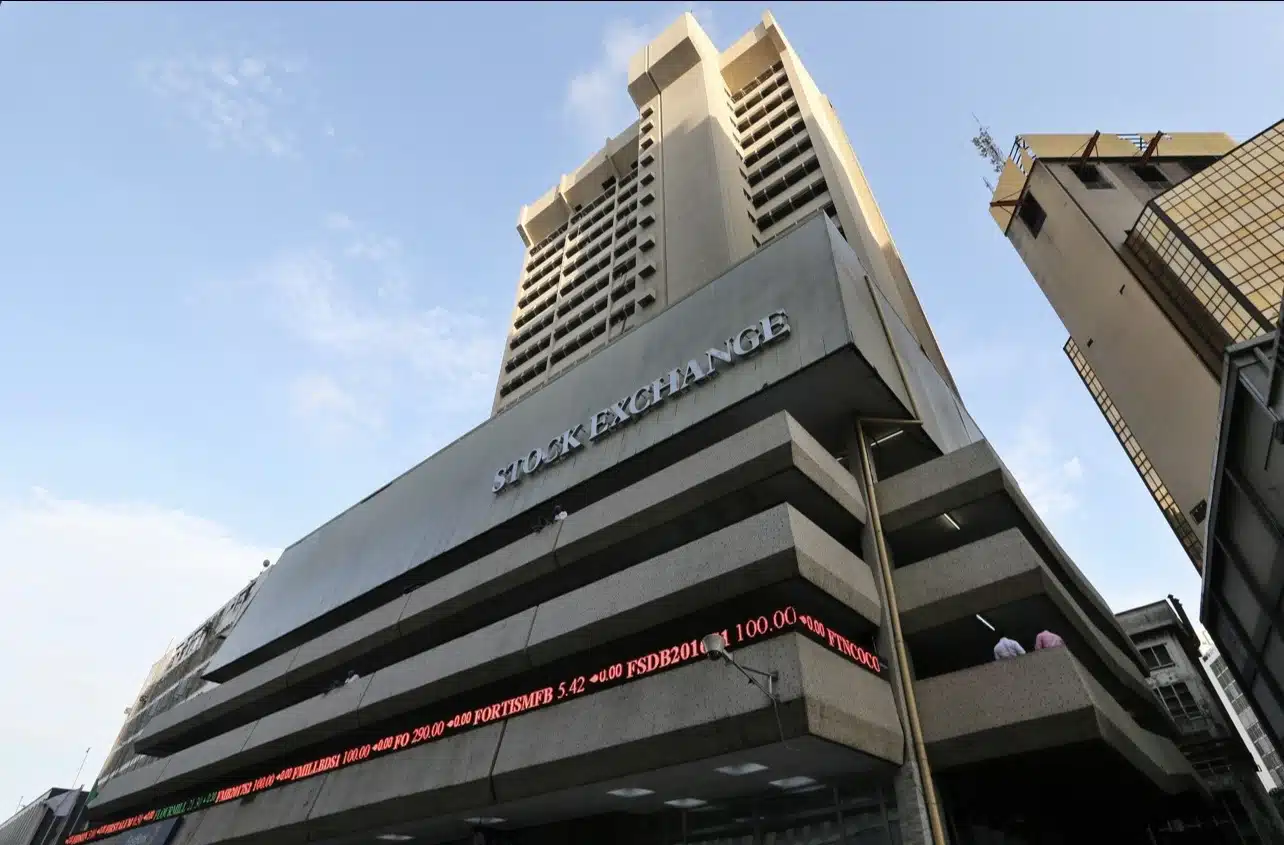



The Ghana Stock Exchange (GSE) led global equity gains at the close of 2025, emerging as the fastest growing bourse by dollar-dominated market capitalisation in December, signaling renewed investor confidence bolstered by improving macroeconomic fundamentals.
Fresh data from the World Federation Exchange (WFE) analysed by Finance In Africa indicates that the GSE’s equity market value surged by 117%% year-on-year to $16.4 billion, extending a three-month run where it consistently outpaced Zambia’s Lusaka Securities Exchange (LSE)
Before falling behind the GSE in September, the LSE held the number one global spot for five of the twelve months in 2025. The bourse’s dollar-dominated market cap rose by 113% in December.
The GSE’s also surpassed other high-performing exchanges including the Bulsa de Electrinica the Chile, 100%; Ljubanja Stock Exchange , 80%; Korea Stock Exchange, 71% and BME Spanish Exchange, 70.5%.
The performance follows a landmark economic turnaround of the West African nation, backed by a $3 billion credit facility from the International Monetary Fund (IMF) which helped to lower inflation and bolster the cedi.
FiA also observed that the exchange was up 54.5% in local currency terms, from GH¢111.35 billion at the close of 2024 to GH¢172 billion last month, representing the third-best performance among global peers.
The WFE is the global industry association representing regulated securities and derivatives exchanges, as well as central counterparties (CCPs).
It tracks over 350 market data indicators from over 250 global exchanges and clearing houses, covering critical metrics such as domestic market capitalisation, trading volumes, and broad stock indexes.
Equities posts strongest gains in two decades
Ghana’s robust rally in 2025 is further reinforced by its stocks benchmark.
The GSE Composite Index (GSE-CI) surged to 8,770.25 points, posting a y/y return of 79.40% in December 2025, its highest annual gain since 2004, according to Exchange’s 2025 market report.
Financial stocks led the rally, with the GSE Financial Stock Index (GSE-FSI) ending the year at 4,647.17 points.
The index recorded a remarkable return of 95.19%, marking its strongest gain since it was introduced in 2011 and underscoring growing investor confidence in the banking and financial services sector.
Market activity also strengthened significantly over the year. Total trade value on the equities market jumped by 73.75% to GH¢3.74 billion, reflecting increased participation by both domestic and foreign investors as macroeconomic recovery gained momentum.
Fixed-income market rebounds
Beyond equities, the Ghana Fixed Income Market (GFIM) also recorded a historic year.
Total traded volume climbed to an all-time high of 245.8 billion, marking a 41.29% increase over the 174 billion traded in the same period in 2024. The volume exceeded the pre-Domestic Debt Exchange Programme peak of 230 billion recorded in 2022.
Treasury Bills contributed 25.14% of total fixed income trades, while Government Notes and Bonds dominated activity with a 69.12% share. Corporate Bonds accounted for the remaining 5.73%.
Major African markets failed to make top 10
Despite rising market capitalisation across Africa, other major stock exchanges failed to emerge among the top ten global gainers.
In dollar terms, the Nigerian Securities Exchange (NSE) recorded a 59.8% y/y increase, rising from $54.4 billion in 2024 to $86.9 billion in December to clinch the 12th spot, according to WFE records.
Nigeria’s performance reflects returning investor confidence despite rising debt levels and elevated inflation as authorities push ahead with sweeping fiscal and financial reforms.
Kenya Nairobi Securities Exchange followed, posting a 52.2% gain, while the Egyptian Stock Exchange closed the year at 47.6%.
Meanwhile, South Africa’s stocks delivered the worst performance among leading economies, with the Johannesburg Stock Exchange (JSE) up by just 36.6%.
Still, the JSE remains Africa’s largest market, boasting a market capitalisation value of about $1.3 trillion as of December 2025.
Cedi gains, disinflation supports Ghana’s stocks rally
The GSE’s historic rally at the close of the year is underpinned by improving macroeconomic conditions in the gold-producing nation.
Helped by a $3 billion IMF bailout package and rising gold-backed reserves, Ghana’s cedi achieved its first annual appreciation against the greenback in 2025, rising by 41% year-on-year, according to data tracked by Bloomberg.
This made it the strongest-performing currency among 144 tracked globally, only behind the Russian Ruble, marking its fastest gain in 32 years.
The rally, coupled with Ghana’s falling debt profile have contributed to easing inflation, which peaked at the height of the country’s economic crisis in 2022.
Consumer prices moderated sharply in 2025 from 24.8% in January to 5.8% in December, after returning to a single-digit threshold in September for the first time in four years. Cooling prices have given policymakers ample leeway to cut interest rates, boosting private sector lending and stimulating economic activity.
With the cedi delivering strong gains and price pressure receding, sovereign borrowing costs have dropped, allowing Ghana to tap cheaper loans to fund critical social spending.
Market observers expected to see sharper equity gains in 2026 as the country’s economic recovery gains further momentum.