
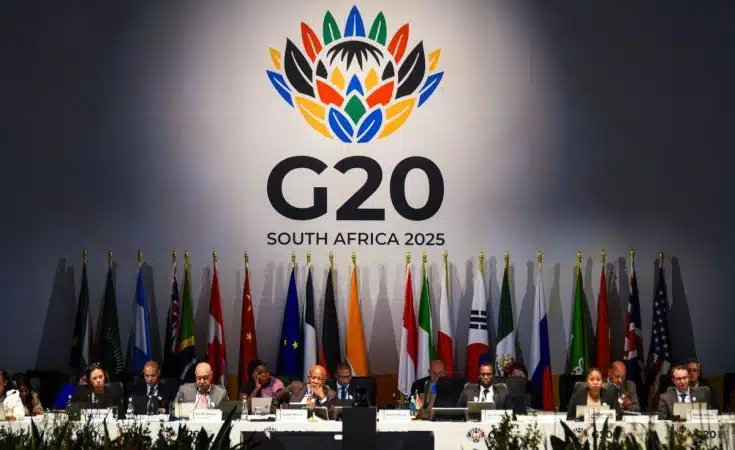


The recent G20 Summit 2025, held in Johannesburg, was abuzz with a myriad of debates that centred on sustainable economic growth, climate action, harnessing critical minerals, among others. Perhaps one of the most critical of these was the conversation around debt sustainability, particularly debt relief for low-income countries.
Many low-income countries had been struggling with mounting debt distress before COVID-19, but the pandemic worsened the problem. In the shadow of soaring Eurobond maturities and post-COVID economic scars, Africa’s low-income countries (LICs) have been facing a debt crisis.
And in the middle of being pummelled by this reality came a promise- the G20’s Common Framework. But the promise, backed by the International Monetary Fund (IMF), has simply prolonged the problem rather than solved it.
Several African countries have spent years negotiating relief for debts they can no longer service, only to emerge with deals that arrive too late to prevent economic damage at home.
The gap between what the Common Framework promised and what it has delivered is widening. And at the centre of that gap sits one problem: how to get private creditors, who hold a significant share of African sovereign debt, to participate in restructurings in a meaningful way.
To understand what’s going on, several questions loom: Why does debt relief matter for Africa? Why is the Common Framework struggling? And what impact could this have for African economies trying to rebuild from overlapping shocks?
How the Common Framework was supposed to help Africa
The Common Framework was introduced in 2020, at a moment when the pandemic had pushed many low-income countries, especially in Africa, to the brink. Borrowing costs had risen, revenues had collapsed, and debt piles that were manageable before COVID-19 suddenly became unpayable.
The G20 designed the Common Framework with one central objective: if a country needed debt restructuring, all creditors, either official or private, would work together under a single, coordinated process.
In practice, this meant G20 leaders, including Paris Club nations like the U.S. and France, alongside newcomers like China and India, multilateral institutions, and private lenders such as Eurobond holders would align on how much debt should be reduced or stretched out. This would be based on IMF assessments.
The whole point was to prevent the delays, disputes, and political bargaining that had plagued previous debt arrangements.
On paper, debt-embattled African countries welcomed the idea. The region’s debt mix had been shifting into dangerous territory. Eurobonds and commercial loans had grown rapidly over the past decade, making private creditors just as important as bilateral lenders.
According to G20 members at the 2025 Summit, there is a recognition “that a high level of debt is one of the obstacles to inclusive growth in many developing economies…many vulnerable low- and middle-income countries face high financing costs, large external refinancing needs, and a significant outflow of private capital.”
A coordinated system sounded like the right fix. But the way it has unfolded tells a different story.
The major problem: Africa’s debt restructuring became slower, not smoother
Four African countries (Zambia, Chad, Ethiopia, and Ghana) have entered the framework at different points. However, none of them experienced the kind of fast, predictable restructuring that the system promised, hinting that the Common Framework could be inadequate in solving the debt problem. In the last G20 Summit, South African Finance Minister Enoch Godongwana had stated that “debt sustainability cannot be solved through the Common Framework alone.”
According to IMF and United Nations Economic Commission for Africa (UN ECA) summaries, all four countries applied for debt treatment between 2020 and 2022, yet by late 2023, only Chad had reached any sort of agreement with its creditors, with Zambia reaching a partial deal. Even then, Chad’s deal did not cut its debt; it simply reprofiled payments.
A recent analysis by ONE Campaign, published in October 2025, finds that the Common Framework has cut just about 7% of the combined external debt stock of “high-risk, lower-income countries (LICs)” in debt distress, roughly $13.6 billion out of a total debt range of $171–184 billion. Most of that relief went to Ghana and Zambia; Ethiopia and Chad saw none.
The problem of the Common Framework can be understood from three interesting angles.
China and Western lenders disagree on how losses should be shared
China is Africa’s largest bilateral lender. Western countries, especially the Paris Club, also hold significant positions. Unfortunately, their stances on debt relief differ:
- China leans toward relief that involves extending repayment timelines (debt extensions) or lowering interest costs.
- Paris Club members favour upfront haircuts to restore debt sustainability quickly.
These differences often slow negotiations. Zambia is a clear example: after defaulting in 2020, it waited more than two years before its official creditors reached an initial restructuring agreement in mid-2023, and talks with private bondholders dragged on even longer.
China’s style of extension is shown in the 2023 agreement for Chinese creditors to reschedule Zambia’s bilateral debt of $6.3 billion over more than 20 years, with a three-year grace period. Also, it was not until 2024 that a preliminary deal could be struck with private creditors.
Private creditors cannot be compelled to accept losses
Private lenders such as bondholders, hedge funds, and commercial banks, hold a big portion of African sovereign debt. In Ghana’s case, they were central to the country’s restructuring.
As of 2022, private creditors accounted for $16.9 billion of the West African country’s external debt while multilateral and bilateral creditors made up much smaller shares. On a wider scale, a 2025 Afreximbank analysis revealed that about 43% of Africa’s public external debt was owed to private creditors, with bondholders dominating that private-creditor share.
This is where it gets tricky: the Common Framework was designed to be voluntary. This means private creditors can delay participation, refuse to accept losses until others (Paris Club members and China) do, or negotiate separately.
There is no legal mechanism to force them to act or punish them for not acting. So, while Paris Club nations and China debate the style of the restructuring, private creditors sit back and watch. They have more to lose if they match restructuring efforts under the framework.
For African governments, the private creditor challenge is the most difficult piece of the puzzle.
Private lenders often argue that they charge high interest because the risk is high, so they shouldn’t be pushed into heavy losses. Some also fear being sued by their own investors if they accept a deeper haircut than necessary.
But the broader issue is incentives. If China or Western governments take a big loss, the country’s fiscal position improves, even if private lenders do nothing. Private creditors benefit without sacrificing anything. That makes waiting a strategic choice.
IMF sequencing rules create stalemates
The IMF often requires “financing assurances” before it can release new support to countries seeking debt relief. This means the IMF needs confidence that the country will have enough money to meet its obligations once new funds are disbursed.
At the same time, creditors want to know who else will take losses before they agree to write down debt or restructure terms. Each creditor wants the others to move first, to avoid being the only one to take a hit.
This creates a circular dependency: the IMF cannot disburse funds without creditor commitments, and creditors will not commit without the IMF’s involvement. As a result, countries are trapped in a kind of economic limbo, unable to get new financing, restructure their debt, or invest in essential services. In Zambia’s case, the IMF had to wait for a creditor agreement before it moved to disburse $188m in debt relief.
How does this affect African economies
Delays under the G20 Common Framework have created clear economic costs for African countries in three ways:
Currency instability
Zambia’s kwacha lost over 30 per cent at several points during its three-year wait for a deal, while Ghana’s cedi fell by more than 50 per cent before its 2023 IMF programme. These swings raise import costs, fuel inflation, and push up the local-currency burden of external debt.
Fiscal tightening
Fiscal cuts deepen as negotiations drag on. Zambia cut public investment to under 3 per cent of GDP during the impasse, and Ghana increased electricity tariffs by more than 50 per cent while trimming subsidies just to preserve cash.
Investor confidence
This erodes as long as restructuring talks remain unresolved. African Eurobond issuance collapsed from $14 billion in 2021 to almost zero by 2023, and countries like Zambia, Ethiopia, and Ghana faced repeated credit-rating downgrades that kept private lenders on the sidelines.
The status quo at the G20 Summit
G20 members pressed for three key reforms at the summit:
Better transparency on who owes what to whom
Africa’s debt is fragmented. Different creditors have different contracts, hidden clauses, and collateral arrangements. Without transparency, restructuring becomes slower and more contentious. The World Bank and IMF both backed a new proposal for a new system for capturing debt data, called the “Debtor Reporting System (DRS)”, but it is still in its early stages.
Wider support for debt reform
As part of the broader process under the G20’s African-focused presidency, members of the G20, in the official G20 Leaders’ Declaration, underlined the need to support “efforts by low- and middle-income countries to address debt vulnerabilities … in a comprehensive and systematic manner.” However, faith in the Common Framework (CF) is dwindling. Yunnan Chen and Tom Hart, research analysts at ODI Global, describe the CF restructuring process as “too little, too late and too complex, highlighting the challenge of “supporting inter-creditor equity to enable swift, efficient restructurings.”
Clear timelines for restructurings
As a follow-up from earlier Common Framework cases, there is a clear expression from some participating borrower-country stakeholders for “standardised timelines for each phase of restructuring negotiations,” and for simpler, more transparent restructuring procedures.
Progress, not promises
In the official G20 Leaders’ Declaration after the Johannesburg summit, members reaffirmed their commitment to strengthen the G20 Common Framework for Debt Treatments “in a predictable, timely, orderly and coordinated manner.”
Due to the tardy progress of the early CF test cases, Mark-Anthony Johnson, CEO of JIC Holdings, noted that “A panel of African experts set up by South Africa during its #G20presidency this year recommended a new debt refinancing plan for low-income countries hit by heavy debt repayments, rather than the current focus on rescheduling payments.”
The G20 members appear committed to resolve the problem by making sure the Common Framework survives, but without reforms that force or incentivise creditors, especially private creditors, to coordinate, it will continue to move too slowly for countries that need relief today, not years from now. After all, progress is not built on promises and resolve, but on decisive action.