



Nigeria’s push to build a $1 trillion economy is set to receive a boost from the proposed Lagos International Financial Centre (LIFC), a new initiative aimed at positioning Lagos as a global hub for capital flows, financial services and investment.
The project seeks to attract international banks, asset managers, financial institutions and multinational corporations by creating a specialised jurisdiction designed to meet global standards for financial centres.
According to Nigeria’s Minister of Trade and Investment, Dr Jumoke Oduwole, the initiative is intended to serve as a strategic lever for economic expansion.
“Mr President has set a goal for a $1 trillion economy for Nigeria, and this is one of the catalytic levers that can deliver that. It is a catalyst to move Nigeria, with Lagos as the epicentre, toward becoming a financial and capital hub,” she said.
The centre is also expected to strengthen Nigeria’s trade relationships and attract foreign direct investment through partnerships with investors and institutions in the United States, the United Kingdom, Brazil and the United Arab Emirates under the Enlarge Trade Partnership framework.
The initiative comes as Nigeria seeks to diversify its economy beyond oil by expanding trade, financial services and investment flows amid a shifting global geopolitical environment.
What is the Lagos International Financial Centre?
The Lagos International Financial Centre is a proposed special financial jurisdiction within Lagos designed to host global financial institutions and facilitate international capital flows.
International financial centres typically offer:
- specialised regulatory frameworks
- strong legal protections for investors
- modern financial infrastructure
- a concentration of banks, asset managers and financial intermediaries
Under the proposal, the LIFC would operate as a “city within a city”, providing an environment designed specifically for financial services and international investment.
According to EnterpriseNGR chairman Aigboje Aig-Imoukhuede, successful financial centres are carefully designed to attract global capital.
“International financial centres are deliberate jurisdictions built on safety, predictable returns and specialised characteristics that attract global capital,” he said.
Where will the centre be located?
The financial centre will be situated in Eko Atlantic City, Lagos’s new coastal development that already hosts corporate headquarters, financial institutions and high-end commercial infrastructure.
The location is intended to provide:
- modern office infrastructure
- proximity to Nigeria’s financial institutions
- a secure and well-planned business district
Eko Atlantic is expected to serve as the physical hub of the financial centre.
Who is the LIFC for?
The financial centre is intended to serve several groups within the global financial system.
International banks and financial institutions
Global banks could use the centre as a regional base for West African operations, supporting cross-border lending, trade finance and investment banking services.
Asset managers and investors
Global asset managers and private equity firms could use the centre to deploy capital into African markets while operating within a familiar regulatory environment.
Multinational corporations
Multinational companies operating across Africa could establish regional treasury and financing operations in Lagos.
African companies seeking capital
Large African firms could use the centre to raise funds through capital markets, bond issuance and structured finance.
Professional services firms
Law firms, accounting firms and financial advisory companies typically cluster around financial centres to support international transactions.
What financial activities would take place there?
The Lagos International Financial Centre is expected to support a range of financial services activities, including: cross-border banking, asset and wealth management, capital markets activity, investment banking, project finance, trade finance, fintech and digital financial services.
The concentration of these services is intended to deepen Nigeria’s financial ecosystem and improve access to global capital.
Who is driving the project?
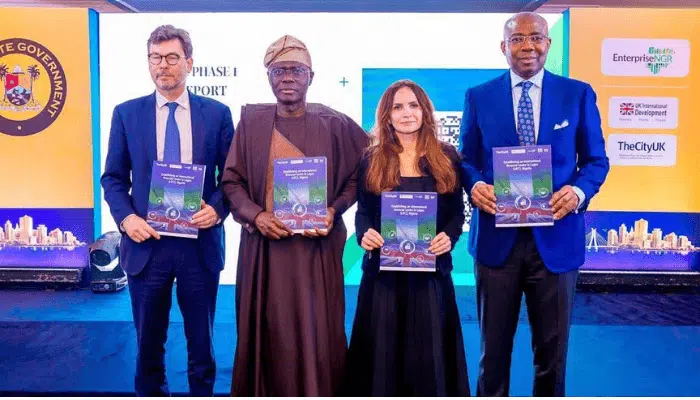
The LIFC initiative is structured as a public-private partnership.
Key stakeholders include:
- the Lagos State Government
- The Federal Government of Nigeria
- EnterpriseNGR, representing private-sector interests
- international partners including TheCityUK
The UK government is providing technical support to ensure the centre aligns with international standards used in established financial hubs such as London.
How did the project reach the implementation stage?
In March 2026, Lagos State Governor Babajide Sanwo-Olu signed an executive order establishing the Lagos International Financial Centre.
The order marked the transition from concept to implementation.
“We can’t do it alone without the support and the belief of the federal government… once they see the benefits, we will see it become reality,” Sanwo-Olu said.
Stakeholders also participated in training programmes at the Mueller Institute at Cambridge University to study international financial centre models.
Why Lagos?
The LIFC roadmap identifies three strategic focus areas where Lagos believes it has an advantage:
- Fintech and financial innovation
- Commodities and capital markets
- Green and sustainable finance
These sectors are intended to differentiate Lagos from other emerging financial centres while leveraging Nigeria’s existing strengths in financial services and natural resources.
The strategy also emphasises Lagos’s: llarge domestic market, strong financial ecosystem, strategic geographic location, private-sector depth.
What is still unclear
Investors will still want clarity on:
- tax competitiveness
- capital controls
- currency convertibility
- dispute resolution frameworks
These are critical determinants of IFC success.
Why does the project matter?
Supporters argue that the financial centre could play a major role in accelerating Nigeria’s economic transformation.
According to Aisha Rimi, Chief Executive Officer of the Nigerian Investment Promotion Commission, Nigeria is seeking to replicate models that have successfully attracted global capital elsewhere.
“Investment in countries where international financial centres have succeeded shows that Nigeria can learn from those models and align with global practices to attract capital,” she said.
Proponents say the centre could help deepen Nigeria’s financial markets, attract multinational financial institutions and improve the country’s global investment profile.
Has this model worked elsewhere?
International financial centres have played a central role in the growth of several global economies.
Countries including Singapore, the United Arab Emirates (Dubai), Hong Kong, and the United Kingdom have successfully used specialised financial districts to attract global capital and strengthen their financial sectors.
According to Senator Adetokunbo Abiru, Nigeria’s ongoing economic reforms create favourable conditions for pursuing a similar strategy.
“This is the right time to align with the global financial ecosystem and attract the capital needed to support growth and development,” he said.
What benefits could this project bring?
If successful, the Lagos International Financial Centre could generate a range of economic benefits.
These include: increased foreign direct investment, expansion of Nigeria’s financial services sector, thousands of high-skilled jobs in finance, law and technology, deeper integration with global capital markets
Advocates also expect the project to strengthen investor confidence by providing a stable environment for both foreign and domestic investment.
Aig-Imoukhuede described the initiative as a potential turning point for Nigeria’s financial sector.
“There has never been a better time for the private sector and government to collaborate on a transformational project like an international financial centre,” he said.
What regulatory framework will govern the LIFC?
What we know
The roadmap recommends creating a dedicated international financial centre framework with:
- regulatory clarity
- simplified tax regimes
- transparent governance structures
The project is being coordinated through a LIFC Council, involving:
- Lagos State Government
- EnterpriseNGR
- federal institutions
What is still unclear
Key details have not yet been publicly specified:
- Will LIFC have an independent regulator?
- Will the legal system use English commercial law like Dubai?
- Will capital flows be fully convertible?
These will determine global credibility.
What economic role will the centre play in Africa?
What we know
The LIFC is designed to position Lagos as West Africa’s financial gateway. The aim is to make it a hub for international investment and drive capital market development. The key stakeholders expect it to attract foreign investment, deepen financial markets, and mobilise capital for infrastructure and development.
What remains uncertain
The project must still demonstrate: How will it compete with Johannesburg, Casablanca, and Mauritius, which are increasingly becoming hot investment destinations? It also needs to show how it will get global financial firms to actually relocate operations
The bigger picture
The Lagos International Financial Centre represents one of Nigeria’s most ambitious financial infrastructure projects in decades.
If successful, it could transform Lagos into a major gateway for investment into West Africa.
However, as with other financial centres around the world, its success will ultimately depend on whether it can create a regulatory and business environment capable of attracting sustained global capital.