
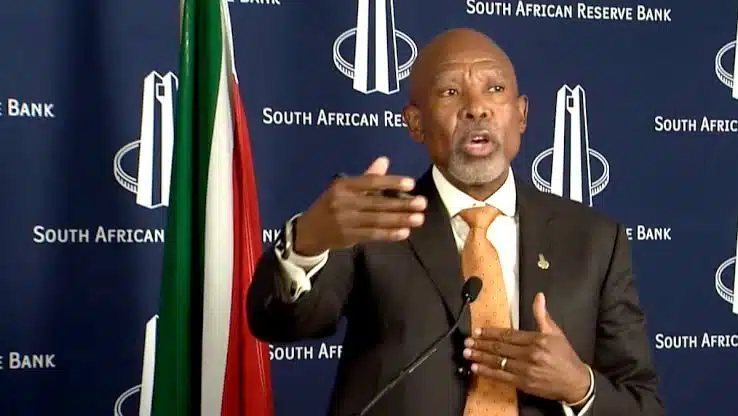


South African Reserve Bank held its benchmark repo rate at 6.75% on Thursday, signalling caution as an oil-driven inflation shock from the Iran conflict disrupts expectations of monetary easing.
The unanimous decision by the Monetary Policy Committee (MPC), announced by Governor Lesetja Kganyago, came as Brent crude oil prices fluctuated wildly around $100–$110 per barrel following supply disruptions in the Middle East. This marks a pause in what had been an anticipated easing cycle, with economists widely forecasting no change ahead of the meeting.
The prime lending rate, which commercial banks use as a reference for consumer and business loans, remains at 10.25%.
Oil shock forces inflation rethink
The Iran war has delivered one of the largest oil supply shocks in recent history, with Brent crude spiking sharply from pre-conflict levels near $70 per barrel earlier in 2026. Prices have swung between peaks above $110–$119 per barrel and recent retreats toward $100 per barrel on ceasefire speculation and diplomatic developments.
For South Africa, a major net importer of crude oil, the surge directly inflates fuel, transport, and food costs, key components of the consumer price basket. The SARB had previously modelled scenarios with Brent at around $75 per barrel; the new reality has forced a reassessment of second-round inflationary effects.
Headline inflation stood at 3.0% in February 2026, aligning with the SARB’s revised target band centred on 3%. However, analysts warn that sustained high oil prices could add up to one percentage point or more to inflation readings in the coming months, pressuring the rand and import costs.
Rand weakness amplifies imported inflation
The South African rand weakened to around 16.97 ZAR per USD in recent trading sessions (equivalent to roughly $0.059 USD per ZAR). This depreciation, driven by safe-haven flows toward the dollar amid geopolitical uncertainty, raises the local cost of dollar-denominated oil imports.
A weaker rand compounds the oil shock: every $10 per barrel increase in global crude translates into higher petrol and diesel prices at the pump, feeding through to broader consumer prices. The SARB had lowered its 2026 inflation projection to 3.3% in earlier forecasts, assuming a more stable currency and lower energy costs. That outlook is now under review.
Growth risks mount as easing cycle delayed
South Africa’s economy, already confronting structural challenges including subdued growth forecasts of around 1.4% for 2026, faces additional headwinds from elevated borrowing costs. Before the oil shock intensified, markets had priced in potential 25-basis-point rate cuts later in the year. Forward-rate agreements had even briefly signalled a small chance of a hike at this meeting.
With the hold at 6.75%, the SARB signals caution to anchor inflation expectations and maintain policy credibility under its new 3% target (with a 2–4% tolerance band). However, prolonged high rates could weigh on household consumption, investment, and mortgage affordability, potentially subtracting from GDP growth.
Economists from institutions like Investec and FNB now project that any further easing may be pushed into the second half of 2026 or later, with the repo rate possibly ending the year near 6.50% or higher, depending on how the Middle East conflict evolves.
Governor Kganyago emphasised the need to monitor second-round effects from energy prices and currency volatility before considering adjustments. The next MPC meeting is scheduled for May 2026, when updated growth and inflation projections will provide further clarity.
Global implications for emerging markets
The SARB’s disciplined stance highlights the vulnerability of oil-importing emerging economies to geopolitical energy shocks. While the hold helps stabilise the rand in the near term, it delays relief for debt-burdened households and businesses.
For international investors, South African bonds and equities remain sensitive to both local policy signals and global oil and dollar movements. Persistent volatility in Brent crude could prompt similar caution from other central banks in commodity-dependent regions.
Markets will now watch developments in Iran–US diplomatic talks and their impact on oil supply through the Strait of Hormuz for clues on the trajectory of South African monetary policy.
no