
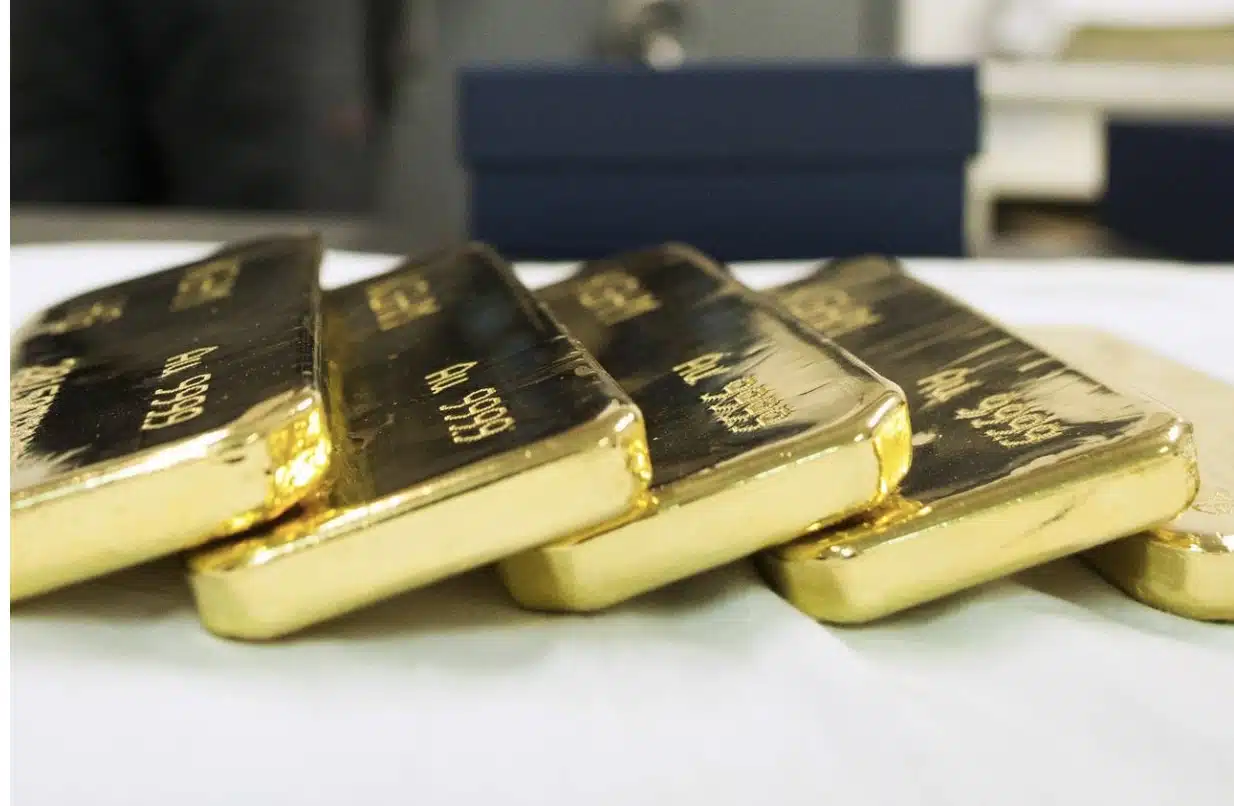


Uganda’s gold exports reached $5.8 billion in 2025, representing a 75.8% increase from $3.3 billion as record global prices attracted new traders and lifted the value of regional flows passing through the country.
This marks a decisive shift in the East African nation’s export profile as bullion outpaced coffee to become the largest foreign exchange earner, according to data from the Bank of Uganda.
The surge places Uganda alongside Ghana and Ethiopia, where gold earnings are increasingly overtaking traditional agricultural exports, reflecting a broader reordering across the region.
Adam Mugume, the central bank’s executive director for research and economic analysis, said the rally in international markets was the key driver. “The attractive gold prices have incentivised new entrants into the business, generating a significant volume of exports,” he told Reuters on Tuesday.
Escalating geopolitical tensions, strong central bank demand and investor appetite for safe-haven assets drive gold prices to move more than 64.% in 2025.
The price rally has amplified export revenues even in countries where production growth remains limited.
A regional trading hub
Uganda’s gold boom is less about domestic mining and more about its role as a regional processing and trading hub.
The country refines and re-exports bullion sourced mainly from neighbouring eastern Democratic Republic of Congo and South Sudan, a function that has expanded as logistics, compliance systems and refinery capacity have improved.
While official production figures remain modest, Uganda’s strategic position has allowed it to capture a growing share of regional gold flows, particularly as traders seek more formalised export routes.
The momentum was reinforced in 2025 with the inauguration of Uganda’s first large-scale industrial gold mine, a Chinese-owned project valued at about $250m. Although output from the project is still at its early stages, policymakers see it as a signal of long-term confidence in the sector and a foundation for downstream processing.
Ghana and Ethiopia mirror trend
Uganda’s experience mirrors developments in Ghana, Africa’s largest gold producer, where bullion has consolidated its position as the country’s dominant export.
By October 2025, Ghana’s gold shipments reached $15.4 billion, compared with $2.8 billion from cocoa, according to data from the Bank of Ghana. The surge helped strengthen foreign reserves and supported a sharp recovery in the cedi, which appreciated by 41% year-on-year, Bloomberg data show.
The stronger currency and rising export receipts contributed to easing inflation, with consumer prices returning to single digits in September for the first time in four years.
Ethiopia has also seen a structural shift. Gold exports exceeded coffee in the fiscal year ended July, traditionally the country’s top source of foreign exchange.
Prime Minister Abiy Ahmed said gold exports climbed to $3.5 billion, compared with $2.65 billion from coffee, highlighting the growing role of minerals in Ethiopia’s external earnings.
Implications for Uganda
For Uganda, the surge underscores how favourable prices, regional trade dynamics and targeted investments can rapidly reshape export earnings, even in the absence of large-scale domestic production.
However, the shift carries risks. Heavy reliance on re-exports exposes the country to regulatory changes in neighbouring states and to volatility in global commodity markets.
Still, officials view the gold sector as a strategic opportunity to boost export earnings amid persistent macroeconomic pressures.
As long as global prices remain elevated, Uganda is likely to consolidate its position as a key conduit in East Africa’s gold trade, with bullion now firmly replacing coffee as the backbone of its export economy.