


Uganda has recorded its first merchandise trade surplus in over a decade, buoyed by a sharp jump in gold exports and resilient coffee earnings, marking a rare turnaround for an economy long defined by systemic deficits.
According to the Finance Ministry’s latest monthly Performance of the Economy report, the East African nation posted a surplus of $147.26 million in January 2026, reversing a $206.43 million deficit in December 2025 and a $215.28 million shortfall a year earlier.
The shift was driven by a surge in export earnings that outpaced a still-elevated import bill.
Gold boom drives historic turnaround
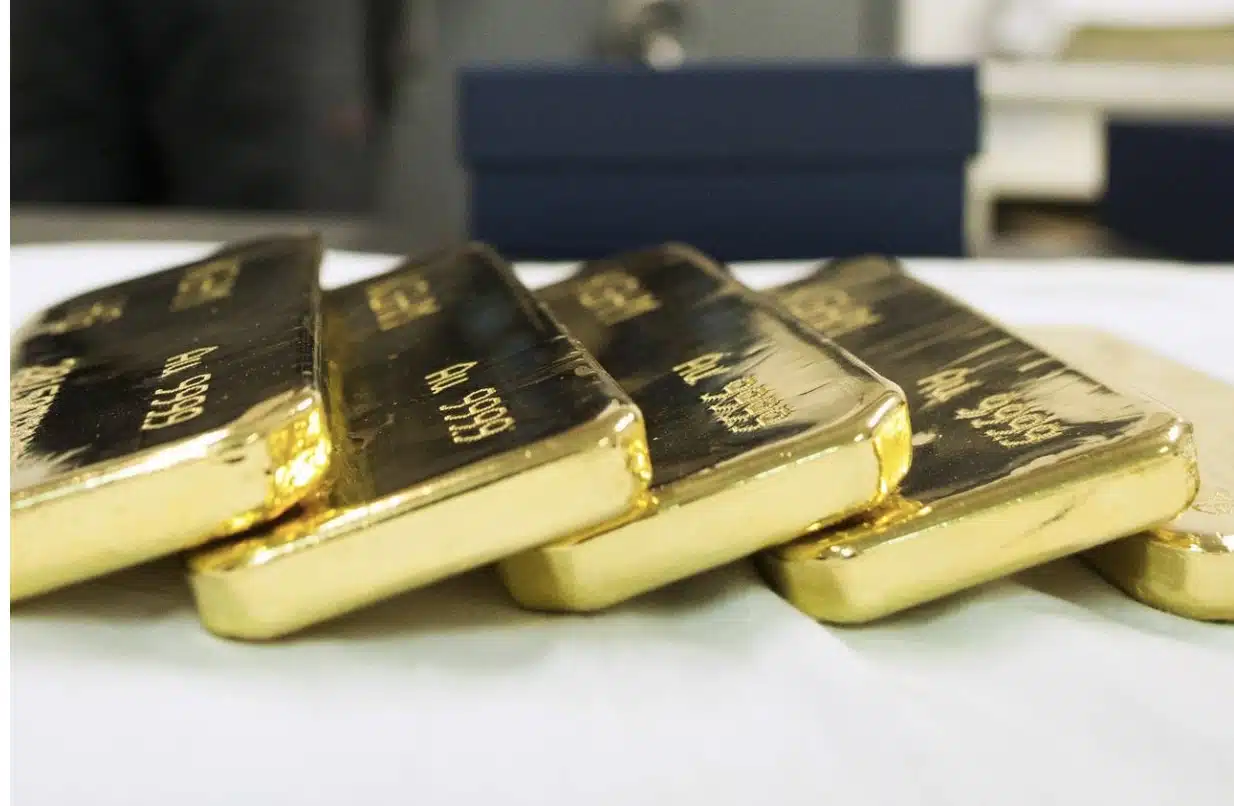
At the centre of Uganda’s trade reversal is gold. Export earnings from bullion rose 182.2% year-on-year to $913.95 million, up from $323.84 million in January 2025, reflecting both higher volumes and a sharp increase in global prices.
Export volumes climbed from 3,873kg to 6,254kg, while average prices surged from about $80,000 per kilogram to over $140,000, underscoring the scale of the rally.
The report attributes the surge to global market dynamics as geopolitical uncertainty and a weaker US dollar pushed investors toward safe-haven assets.
Uganda’s emergence in recent years as a regional gold refining and trading hub has amplified the impact of global price movements, allowing the country to capture greater value from bullion flows across East and Central Africa.
Coffee cushions export performance
While gold dominated, coffee continued to provide a stabilising base. Export earnings rose modestly to $161 million from $156.5 million in January 2024, supported by higher shipment volumes despite softer global prices.
Volumes increased from 558,382 to 569,454 sixty-kg bags, offsetting price declines linked to improved global supply conditions, particularly from Brazil.
Together, gold and coffee accounted for more than 74% of total export earnings, highlighting their outsized role in Uganda’s external sector.
Exports surge past import pressures
Overall merchandise exports rose 72.1% year-on-year to $1.45 billion in January, driven not only by gold and coffee but also by industrial products, electricity and oil re-exports.
Imports, by contrast, increased by 23.2% to $1.31 billion, reflecting higher private sector demand for machinery, mineral products and fuel. Despite this, the rise in exports was sufficient to swing the trade balance into positive territory.
The central bank emphasised that the surplus was achieved because “the increase in the import bill was more than offset by the increase in export earnings,” marking a notable departure from Uganda’s typical trade dynamics.
Middle East demand anchors export flows
A critical factor behind the export surge is Uganda’s growing reliance on the Middle East, which accounted for 48.9% of total exports in January.
The United Arab Emirates alone absorbed 99% of shipments to the region, underscoring a high degree of market concentration—particularly for gold.
Other destinations included Asia (18.4%), the East African Community (17.9%) and the European Union (10.5%), but none matched the scale of Middle Eastern demand.
This geographic concentration has been instrumental in driving recent gains but also introduces a layer of vulnerability at a time of heightened geopolitical uncertainty.
Geopolitics threatens fragile gains
The ongoing conflict involving the United States, Israel and Iran—now in its fifth week—has become a key external risk. With neither Washington nor Tehran agreeing to individual terms of peace, the prospect of a prolonged standoff is increasing.
For Uganda, the implications are direct. Any disruption to trade flows or financial channels linked to the Gulf region could quickly erode export earnings, particularly given the region’s dominance as a destination for gold.
At the same time, the precious metal’s rally has begun to wane.
Bullion prices fell by over 20% from their early March $5,419 per ounce high, with analysts pointing to rising bond yields, a stronger US dollar and profit-taking after a sustained rally as the primary factors driving the decline.
This creates a precarious balance: the same external forces that delivered Uganda’s surplus could reverse just as quickly.
Underlying vulnerabilities resurface
Beyond geopolitics, Uganda’s trade position continues to reflect deeper structural constraints.
The country remains a net importer of fuel and industrial inputs, resulting in persistent deficits with regions such as Asia, where it recorded a $174.88 million trade shortfall in January. Imports from the continent and other regions also continue to outpace exports in key categories.
More fundamentally, the concentration of exports in a narrow set of commodities leaves Uganda exposed to price volatility. Gold and coffee, while lucrative, are both highly sensitive to global market conditions beyond the country’s control.
This dependence raises questions about the sustainability of the current surplus, particularly if commodity prices weaken or demand from key markets slows.
Outlook: surplus under pressure
In the near term, momentum may persist, given that the Iran war broke out towards the end of February.
However, the outlook beyond that is far less certain. A cooling precious metal market, combined with unresolved geopolitical tensions and heavy reliance on a single export corridor, could quickly push Kampala back into deficit.
The January surplus, while significant, may therefore represent less a structural shift than a cyclical high point driven by favourable external conditions.
Sustaining it will depend on Uganda’s ability to broaden its export base, deepen value addition and reduce its exposure to commodity and geographic concentration—factors that remain central to the country’s long-term trade resilience.