
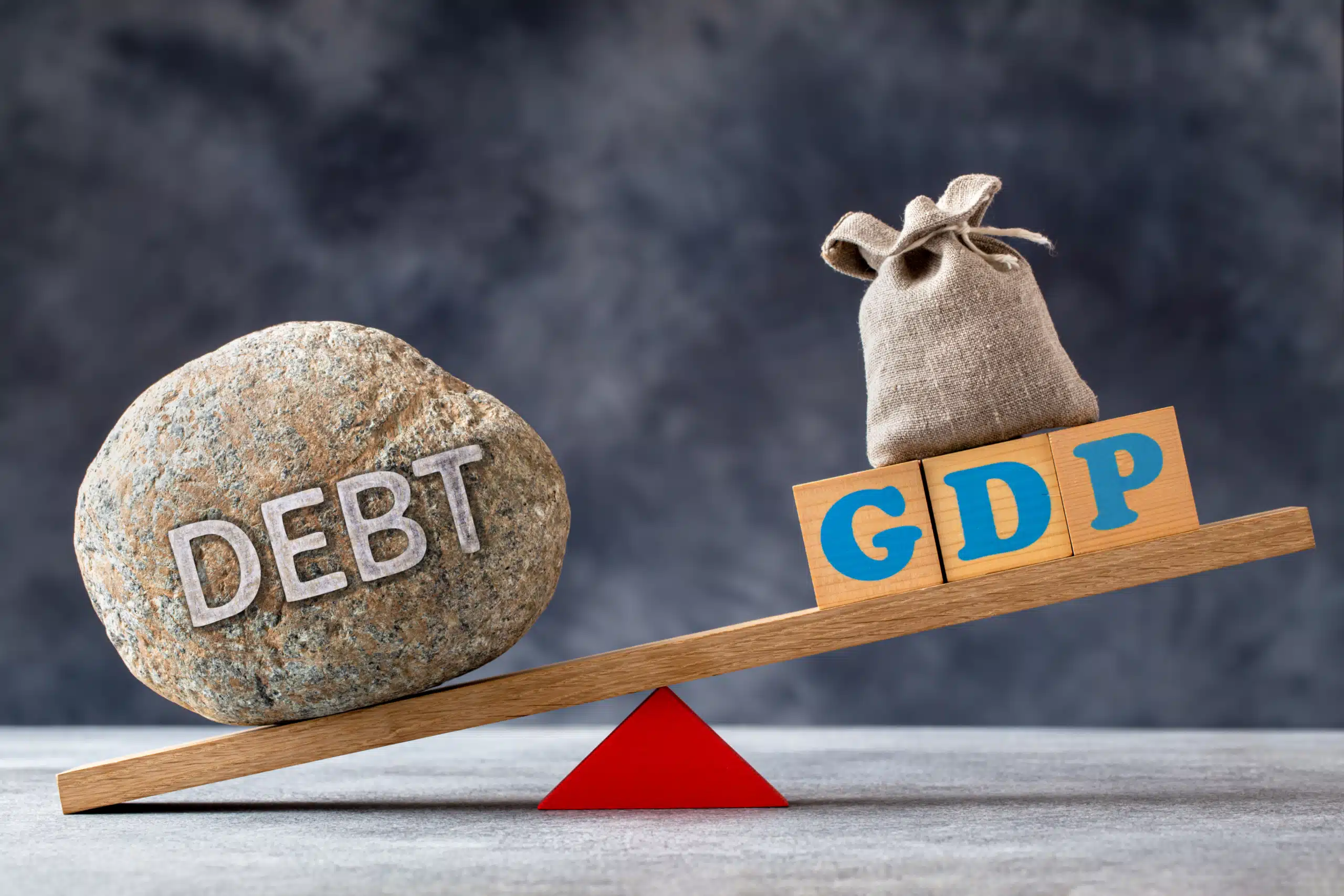


Kenya channelled a significant share of its public finances toward servicing foreign debt in the second half of 2025, underscoring the growing weight of borrowing costs on the country’s fiscal position.
New figures released by the National Treasury of Kenya show that the government spent $2.92 billion (KSh376.4 billion) servicing external debt between July and December last year.
The payments, which include both installments on borrowed sums and interest charges, reflects 24.5% of the government’s total revenue of $11.81 billion (KSh1.53 trillion) over the same period.
In simple terms, nearly one in every four shillings collected by the state went toward meeting obligations to external lenders.
A breakdown of the servicing bill shows that $2.10 billion (KSh271.7 billion) or 72.2% of the total was deployed to repay the original figure borrowed while the remaining $811.0 million (KSh104.7 billion) covered interest accrued over time.
While both elements form part of routine debt servicing, principal repayments place greater pressure on public finances because they directly reduce the outstanding debt stock.
Kenya’s debt burden has expanded steadily over the past decade as the government financed large infrastructure projects and bridged fiscal deficits. By December 2025, total public debt had reached KSh12.3 trillion, up from KSh10.9 trillion six months earlier.
$486m payment to China
Among Kenya’s bilateral creditors, China continued to receive the largest share of payments during the six-month period.
The Treasury reported that Beijing was paid $486.4 million (KSh62.8 billion), comprising $343.1 million (KSh44.3 billion) in principal installments and $144.1 million (KSh18.6 billion) in interest.
That figure represents 67% of the $725.8 million (KSh93.7 billion) Kenya paid to bilateral lenders overall and exceeds the combined amount directed to other major creditors such as France, the US and Italy.
China’s prominent position reflects years of financing for large infrastructure projects, including railways, highways and energy facilities. Analysts estimate that about 70% of Kenya’s bilateral debt is owed to Chinese lenders.
However, the largest portion of Kenya’s external servicing bill is owed not to governments but to commercial creditors, including Eurobond investors and international banks.
Payments to this group reached $1.72 billion (KSh222.24 billion), accounting for 59% of the total servicing outlay.
Meanwhile, a $279.6 million (KSh36.1 billion) payment to the International Development Association (IDA), the concessional lending arm of the World Bank, pushed multilateral servicing to $467.9 million (KSh60.4 billion), representing 16.1% of the total bill. Bilateral lenders accounted for 24.9%.
Revenue gaps and budget shortfalls
Kenya’s heavy debt obligations come at a time when government revenues have struggled to keep pace with spending needs.
During the last six months of 2025, the government missed its $12.63 billion (KSh1.63 trillion) revenue target by $859.8 million (KSh111 billion), collecting $11.85 billion (KSh1.53 trillion) instead..
The shortfall was largely driven by weaker ordinary revenue — taxes such as income tax, value-added tax and excise duties. These collections fell short by $856.7 million (KSh110.6 billion).
One area that slightly offset the gap was Appropriations-in-Aid (AiA), which exceeded its target by $7.7 million (KSh1.0 billion).
AiA refers to revenue generated directly by government ministries, departments and agencies through services they provide—such as licensing fees, administrative charges or income from state-owned facilities. Instead of sending these funds entirely to the central treasury, the agencies retain part of the money to finance their operations.
Even with this modest boost, ordinary revenue reached $9.61 billion (KSh1.24 trillion), below the $10.47 billion (KSh1.35 trillion) target.
Some categories did outperform expectations. Investment income exceeded projections by $128.6 million (KSh16.6 billion), import duty collections came in $7.7 million (KSh1.0 billion) above target, and Import Declaration Fees (IDF)surpassed projections by $999,000 (KSh129 million).
“Overall, total revenue grew by 11.4% year-on-year, an improvement compared with the 4.2% growth recorded in December 2024,” according to the latest Quarterly Economic and Budgetary Review.
Despite stronger revenue growth, spending continued to outpace income. Government expenditure reached $15.65 billion (KSh2.02 trillion), driven partly by rising wage bills, leaving a budget gap of $3.97 billion (KSh512.5 billion).
Borrowing fills the gap
To cover this deficit, the government increasingly relied on domestic borrowing.
By December 31, 2025, new domestic borrowing had reached $4.30 billion (KSh554.9 billion)—a sharp shift from the first half of the year when authorities focused on retiring maturing obligations rather than raising new funds.
After accounting for $415.2 million (KSh53.6 billion) paid to local creditors, net domestic borrowing stood at $3.88 billion (KSh501.3 billion), slightly above the $3.76 billion (KSh485.6 billion) target.
Most of the financing came from financial corporations, which provided $3.27 billion (KSh422.2 billion). Additional funds came from households, non-residents, government entities, and non-profit institutions. Non-financial corporations recorded a net repayment of $68.9 million (KSh8.9 billion).
As a result, Kenya’s stock of gross domestic debt rose from $45.47 billion (KSh5.87 trillion) in December 2024 to $52.97 billion (KSh6.84 trillion) by December 2025, an increase of $7.52 billion (KSh971 billion).
External financing remains modest
By contrast, external borrowing during the same period was comparatively modest.
Total external financing reached $2.16 billion (KSh279.5 billion), exceeding the target of $899.3 million (KSh116.1 billion). However, after deducting $2.10 billion (KSh271.7 billion) in principal repayments, net external borrowing amounted to just $60.4 million
“The (total disbursed)amount comprised principal repayments due to commercial sources amounting to KSh166.9 billion, bilateral sources KSh70.9 billion, and multilateral sources KSh33.9 billion respectively,” the Treasury said.
Kenya’s gross external public debt stood at $42.34 billion by the end of December 2025, up from $39.11 billion a year earlier.
Managing mounting debt pressures
Authorities in Nairobi have increasingly adopted proactive measures to ease debt pressures and reassure investors about the country’s ability to meet its obligations.
Among those steps was the launch of a $500 million debt buyback tender, a strategy that allows a government to repurchase some of its outstanding debt before maturity—effectively settling obligations earlier rather than continuing with scheduled installments over several years.
The move followed a period of acute market stress in 2024, when concerns about Kenya’s capacity to service its debt rattled investors. The anxiety triggered a downgrade in the country’s sovereign credit rating and piled pressure on the Kenyan shilling.
At the same time, East Africa’s largest economy has been exploring a fresh programme with the International Monetary Fund IMF after a $3.6 billion financing arrangement expired in April 2025. Such programmes typically provide not only funding but also a policy framework that reassures international lenders about a country’s fiscal direction.
IMF talks stall over debt treatment
Many economists believe a new IMF programme could help anchor investor confidence and support Kenya’s external financing strategy.
Negotiations have stalled, however, partly due to disagreements over securitisation, a financing technique in which governments package future revenue streams—such as tax receipts—and sell them to investors through special-purpose vehicles to raise funds upfront.
Kenyan authorities argue that once rights to those revenue streams are transferred, the resulting financing should not necessarily be classified as public debt.
The IMF has taken a more cautious stance, insisting that such arrangements may still carry fiscal risks. The disagreement has delayed a new programme nearly a year after the previous one expired.
Despite the impasse, Finance Minister John Mbadi has downplayed the urgency of IMF support.
“If it comes, it will be a windfall for us… It may help us reduce some other loans, whether domestic or external,” Mbadi told Reuters in an interview late last year.
Kenya returns to international markets
With concessional financing slowing, Kenya has turned once again to global capital markets.
In February, the country raised $2.25 billion through a Eurobond issuance, part of which will support the budget and the $500 million buyback.
The move was supported by the country’s gradually improving credit sentiment as near-term liquidity returns to sustainable levels.
Between August 2025 and January 2026, the African nation secured sovereign rating upgrades from both Moody’s and S&P Global, pointing to improved financing conditions supported by strong exports and diaspora remittances.
These external buffers have helped to strengthen the country’s macroeconomic fundamentals despite rising debt costs.
Economic resilience despite debt strain
Through 2025, consumer prices remained below the 5% midpoint target set by the Central Bank of Kenya, buoyed by a stable currency and growing foreign exchange reserves
At the same time, the economy continued expanding, with growth estimated at 4.9% in Q3 2025, slightly lower that the 5% recorded in preceding quarter.
But economists caution that stability on the surface masks a deeper fiscal constraint.
Large debt-servicing obligations mean that a growing share of government resources are absorbed by past borrowing rather than being directed toward new development priorities. This reduces the financial room available for investments in infrastructure, social services and economic stimulus.
In its latest review of Kenya’s economic performance, the IMF urged authorities to continue to “strengthen fiscal discipline, enhance fiscal credibility, and build resilience to external shocks,” adding that these efforts should be supported by stronger governance and improved public-sector efficiency.
How effectively the government manages this balancing act will likely shape the country’s fiscal trajectory in the years ahead.
NB: $1=Ksh129.1 as of 2025