



On March 31st 2026, Nigeria announced it would borrow $5 billion from First Abu Dhabi Bank through a financial instrument most people have never heard of: a total return swap. The deal is equivalent to roughly a tenth of Nigeria’s entire budget this year. Parliament approved it the same day the request was submitted.
That detail matters. A $5 billion borrowing decision, cleared in hours, was built around a derivative instrument whose risks take time to unpack even for experienced investors. It speaks to the pressure African governments are under right now, and what that pressure is pushing them toward.
Nigeria isn’t alone. Angola has borrowed about $1.5 billion through similar arrangements; Senegal tapped $1.3 billion across seven separate deals last year.
Joseph Cotterill, the Financial Times’ emerging markets correspondent, cuts to the definitional question directly: “Is it a total return swap?… Is it a camouflaged secured loan either way? Whatever you call them, they are spreading across sovereign debt as an alternative to expensive bond market access. In Africa, deals by Nigeria, Angola, and Senegal are those that have become public or semi-public so far. I doubt they will be the last.”
The implications go beyond government balance sheets. They touch on how African sovereign risk gets priced, how creditors are beginning to behave, and how well the international frameworks built to monitor debt are actually working.
The instrument nobody talks about
A total return swap (TRS) is a way to get cash without selling a bond. Instead of going to capital markets and issuing new debt, a government hands over bonds it already holds as collateral to a lender and receives cash in return. The government agrees to repay the cash plus a fee. If the bonds fall in value, the government tops up the collateral with more bonds or cash. That is called a margin call.
On paper, this looks like a cheaper way to borrow. Nigeria will pay roughly 4 percentage points above SOFR (Secured Overnight Financing Rate), which is the floating dollar benchmark rate that currently sits at 4.14% as of April 17, 2026. This brings its total cost to about 8.1%. That is roughly in line with, and in some cases a little below, what its international bonds are yielding right now, which have climbed to between 7.5% and 8.5% as global borrowing costs have risen.
Senegal’s finance minister Cheikh Diba said the country paid 7% on its swap deals last year against double-digit rates on international bonds, saving roughly $64 million. For a government stretched by high debt costs, those savings are real. The problem is what the instrument hides.
The debt that only counts in a crisis
When a government borrows through a total return swap, the cash is recorded as external debt. But the bonds pledged as collateral are excluded from official debt figures, on the assumption that the government will repay the loan and the bonds will simply be retired.
That assumption holds in normal times. In a default, the collateral immediately enters the picture. Angola borrowed $1 billion and pledged $1.9 billion in bonds to secure it, nearly double the cash received. When markets moved against them in April 2025, that gap became a $200 million margin call overnight.
Daniela Gabor, Professor of Economics at UWE Bristol, explains the mechanics: “In TRS, governments post a combination of US Treasuries and local currency government bonds. Should these fall in prices, the borrowing government has to post additional cash or collateral. These total return swaps are cheaper for the Global South until the collateral drama explodes into margin calls.” As Angola found, that explosion can happen fast.
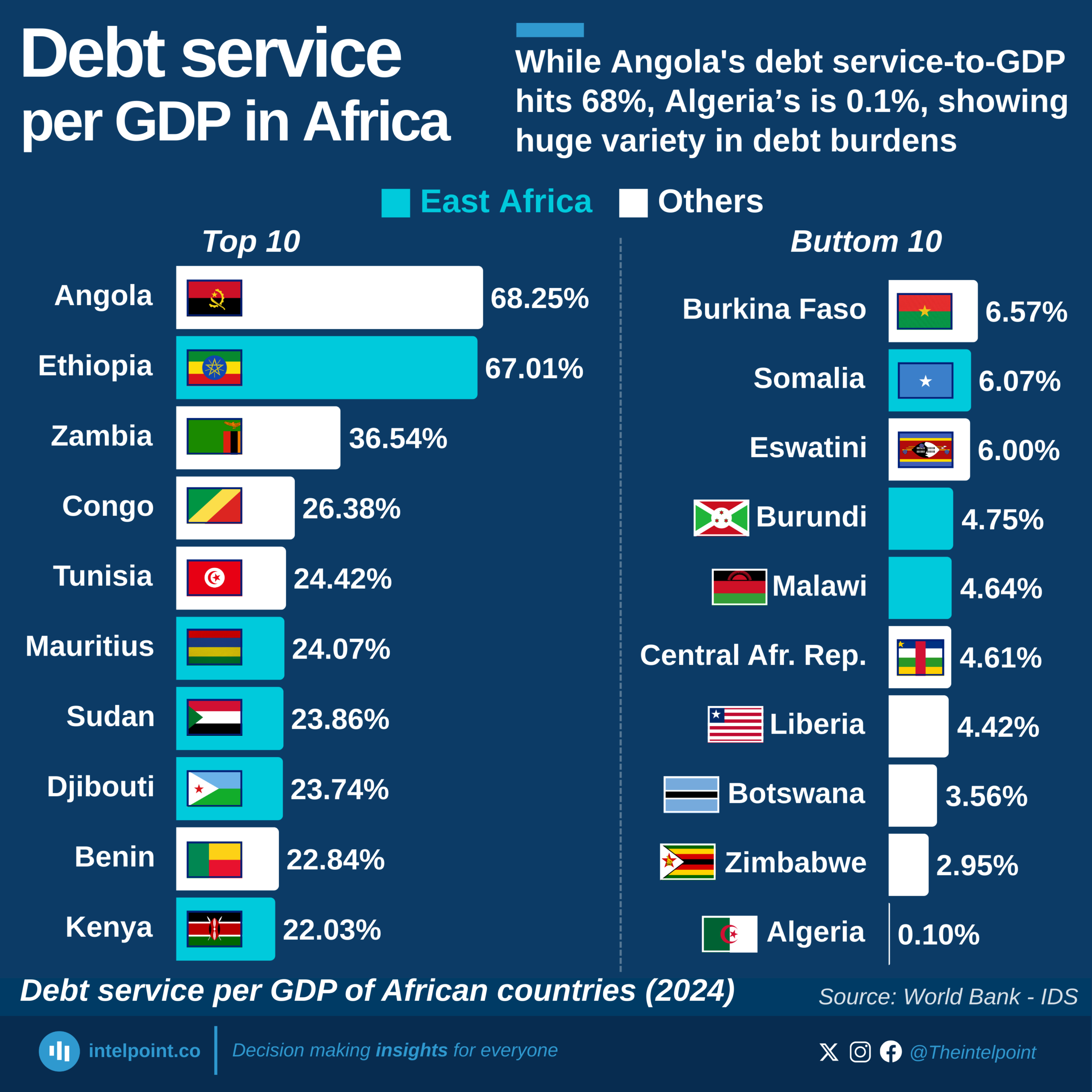
Nigeria’s deal follows the same structure: naira-denominated bonds are pledged as collateral, typically worth about 130% of the amount drawn. If market conditions deteriorate, additional liabilities could crystallise quickly.
Yvette Babb, emerging market debt portfolio manager at William Blair, spells out the exposure: if naira bonds fall in value, Nigeria must cover margin calls in US dollars, a serious risk if the naira depreciates or inflation forces the central bank to raise interest rates.
On the speed of approval, she noted: “the request for the financing was submitted to parliament and was approved on the same day…You would expect there would be a more robust assessment of the risks before approval of issuance.”
What opacity does to pricing
The problem with undisclosed contingent liabilities is largely computational. Investors price sovereign debt using the figures they can see. When those figures are incomplete, the models used to calculate default probability, expected loss, and appropriate yield are working from an undercount.
Opacity tends to push pricing in two directions: investors who suspect hidden liabilities demand higher yields to compensate, while those relying on disclosed data alone risk underpricing exposure, with sharp corrections when stress hits.
This matters most for Africa, where the gap between perceived and actual risk is already well-documented. In 2024, African countries paid roughly 9% on dollar-denominated bonds, higher than any other emerging region, compared to 6.5% in Latin America and 4.7% in emerging Asia. Total return swaps make accurate pricing harder, not easier.
Nicholas Sauer, portfolio manager at Robeco, captures the bondholder concern precisely: “For bondholders, the lack of transparency of both the transaction and the accounting of the debt are risks, as is the effective subordination in the capital structure.” When investors can’t see the full creditor stack, they can’t accurately price where their claim sits. A bond that appears senior may not be.
How creditor behaviour is shifting
The opacity is already changing how creditors engage with African sovereign debt. When Fitch downgraded Afreximbank to junk in January 2026, the market split immediately. Some institutional investors sold, as their mandates required. JP Morgan upgraded its view on Afreximbank bonds to “overweight” within days, arguing the sell-off had created value and fundamentals remained intact.
That divergence reflects a broader willingness among larger creditors to form their own view rather than treat official figures as final. But the consequences are asymmetric. Banks and large asset managers with resources for deep independent analysis can look past incomplete disclosures.
Smaller institutions, or those with stricter compliance frameworks, cannot. They exit or demand a blanket premium, narrowing the effective investor base and pushing up borrowing costs for the very governments using swaps to make borrowing cheaper.
There is also a structural shift in how creditors read their legal protections. Bondholders who entered negative pledge agreements, formal commitments that governments would not issue debt ranking above theirs, now face a practical loophole. Total return swaps are classified as derivatives, not public external debt, so those clauses don’t apply.
As Thierry Larose, portfolio manager at Vontobel, puts it: “Total return swaps (TRS) are creating ‘grey zones’ in the creditor hierarchy, and the distinction matters: Colombia’s TRS was a mere carry trade punt, while deals like Senegal’s are fundamentally about market access.”
That grey zone is reordering creditor behaviour. Investors who understand that swap lenders effectively sit ahead of them are pricing in that risk. Left unchecked, it won’t stay a temporary concern. It becomes a built-in cost that keeps Africa’s borrowing rates structurally higher.
A gap in the frameworks built to prevent this
The international frameworks designed to catch exactly this kind of risk are struggling to keep pace.
The IMF’s Debt Sustainability Framework relies on accurate, disclosed debt figures. It includes provisions for contingent liabilities and acknowledges the risk of hidden public debts. But total return swaps occupy a classification grey zone that the existing guidance doesn’t fully address.
The cash advanced is counted. The collateral is not, as long as the swap is performing. In Angola’s case, roughly $1 billion in financing was backed by $1.9 billion in pledged bonds, leaving a substantial portion of risk outside headline debt figures. That gap affects how the IMF conducts surveillance, assesses programme countries, and estimates the cushion before restructuring becomes necessary.
The Paris Club faces a parallel problem. The comparability of treatment principle, which requires all creditors to accept broadly similar terms in a restructuring, presupposes a clear creditor hierarchy.
Total return swap lenders don’t fit neatly: they’re not bondholders, not bilateral creditors, but derivative counterparties holding sovereign collateral. Whether they fall within the perimeter of a Paris Club restructuring is unsettled. Investors are actively seeking guidance from both institutions. None has arrived.
Lee Buchheit, a veteran sovereign debt lawyer, points to a deeper fragility in the assumption swap lenders are making, that domestic debt used as collateral will receive gentle treatment in a workout: “The rationale for treating domestic debt more gently in a sovereign debt workout is the need to cushion the blow to local financial institutions like banks and pension funds.
But when domestic debt instruments are manufactured and lodged with a foreign financial institution as security for a repo or swap arrangement, that issue does not arise.” The protection that makes domestic bonds attractive collateral evaporates once those bonds leave domestic hands.
The Africa premium, compounded
African countries are projected to raise $155 billion in commercial markets in 2026, according to S&P Global, against external debt repayments exceeding $90 billion. Some issuers are still turning to total return swaps precisely because conventional market yields remain too expensive.
But as Misheck Mutize, Lead Expert at the African Peer Review Mechanism, points out, the deeper problem is what these borrowings are actually financing: “New borrowings remain driven more by liquidity pressures rather than growth-oriented investment.” These instruments are not funding roads or power grids. They are buying time. And buying time at a hidden cost compounds quietly until it doesn’t.
Samir Gadio, head of Africa strategy at Standard Chartered, expects the pipeline to keep growing: “We are going to see more of these transactions in the foreseeable future, especially if regular and conventional Eurobond market access remains constrained for single B and low-rated countries.”
Until the IMF and Paris Club issue clearer classification standards, investors will keep filling in the blanks themselves and pricing the uncertainty accordingly. Total return swaps are not just an alternative financing tool. They are a new layer of opacity on top of a market already struggling to accurately read African sovereign risk.
Angola and Nigeria are far from default today. Oil near $100 a barrel provides real buffer. But the deals being signed now will still be on the books when conditions turn. That is when the accounting will matter most, and when what is invisible will suddenly, and expensively, come into view.