


For decades, moving money across Africa has often taken a strange and long-winding route.
A Kenyan entrepreneur paying a supplier in Ghana might see the payment leave Nairobi, pass through banks in Europe or the United States, convert into dollars along the way, and only then arrive in West Africa.
The transaction can take days. To make matters worse, fees accumulate at every step. To further convey the scale of the problem, if the Kenyan trader had travelled to Ghana to deliver the money himself, he would arrive with the cash before the electronic payment went through.
This is perhaps the major reason cross-border payments in Africa remain among the most expensive in the world. Sending $200 to the region costs about 7.9%-8.3% on average, according to the World Bank, well above the global average of roughly 6.5%. Some African payment corridors cost far more, up to 8%–36%, depending on the route.
Structural issues such as currency conversions through dollars or euros add around $5 billion in extra costs annually to African transactions because of double currency conversions, according to The Guardian.
The launch of the Pan-African Payment and Settlement System (PAPSS) was meant to change that. Created by the African Export–Import Bank, more commonly known as Afreximbank, and backed by the African Union, the system aims to allow African businesses, banks, and individuals to send money across borders instantly while settling transactions in local currencies.
But building a continental payment network is not just about creating a central platform. It requires strong domestic infrastructure capable of connecting to it.
That is where Kenya’s latest move comes in.
A new partnership linking Pesalink, Kenya’s real-time bank transfer system, with PAPSS offers a glimpse of how Africa’s payment integration might actually work in practice. More importantly, it highlights a reality that is becoming increasingly clear: continental financial systems can only scale if national payment rails are strong and interoperable.
In other words, PAPSS may be the continental layer. But systems like Pesalink are the pipes.
A long-standing bottleneck in African trade
Africa’s trade ambitions have expanded rapidly in recent years, especially with the launch of the African Continental Free Trade Area, which links 54 out of 55 African countries into a single market, with Eritrea being the only country yet to sign the agreement. By the number of participating states, AfCFTA is the largest free trade area in the world, connecting about 1.3 billion people and an economy worth roughly $3.4 trillion.
The European Union trails behind with 27 participating countries and the ASEAN Free Trade Area with 10.
Yet one of the biggest barriers to intra-African trade has never been tariffs alone. It has been the difficulty of paying across borders.
Traditional cross-border payments often rely on correspondent banking networks. If two African banks do not have a direct relationship, a payment would have to pass through intermediary banks abroad before reaching its destination.
That routing increases both time and cost. It also means African transactions are frequently settled in foreign currencies such as the U.S. dollar or euro rather than in local currencies.
Mike Ogbalu III, CEO of PAPPS, has repeatedly argued that this structure reflects a deeper weakness in Africa’s financial architecture.
“If you have a situation where Africa’s trade is dependent on a payment system that is not controlled by it, that is not fit for purpose. You have a situation where sometimes people are able to determine to say we do not want this African country to trade”, he warned.
The current structure also adds significant delays to payments.
The result is a system where moving money between two African countries can sometimes be slower and more expensive than sending funds between continents. In many African corridors, transfers can take 3–7 business days, especially when routed through correspondent banks and foreign clearing systems. Some corridors can take up to 10 days when multiple intermediary banks are involved.
Meanwhile, newer and global digital payment rails can complete cross-border transfers within minutes or hours, underscoring how inefficient traditional intra-African payment routes remain.
According to Benedict Oramah, whose second term as president of Afeximbank ended in October, 2025, “One of the greatest barriers to intra-African trade has been the lack of efficient cross-border payment systems, which have created leakages of around $5 billion dollars annually.”
PAPSS was designed to address that problem. The system allows banks in participating countries to send payment instructions through a single platform while settlement is handled through participating central banks and Afreximbank. In principle, this allows payments to be completed within minutes instead of days.
“Businesses can trade more freely and competitively by eliminating the need for correspondent banks outside the continent and removing dependencies on third-party currencies. This transformation is set to unlock new opportunities for trade and investment, allowing African SMEs to access broader markets and contribute to local economies,” Ogbalu III expressed.
But the platform’s effectiveness depends heavily on how well it connects to domestic financial systems.
Why national payment systems matter
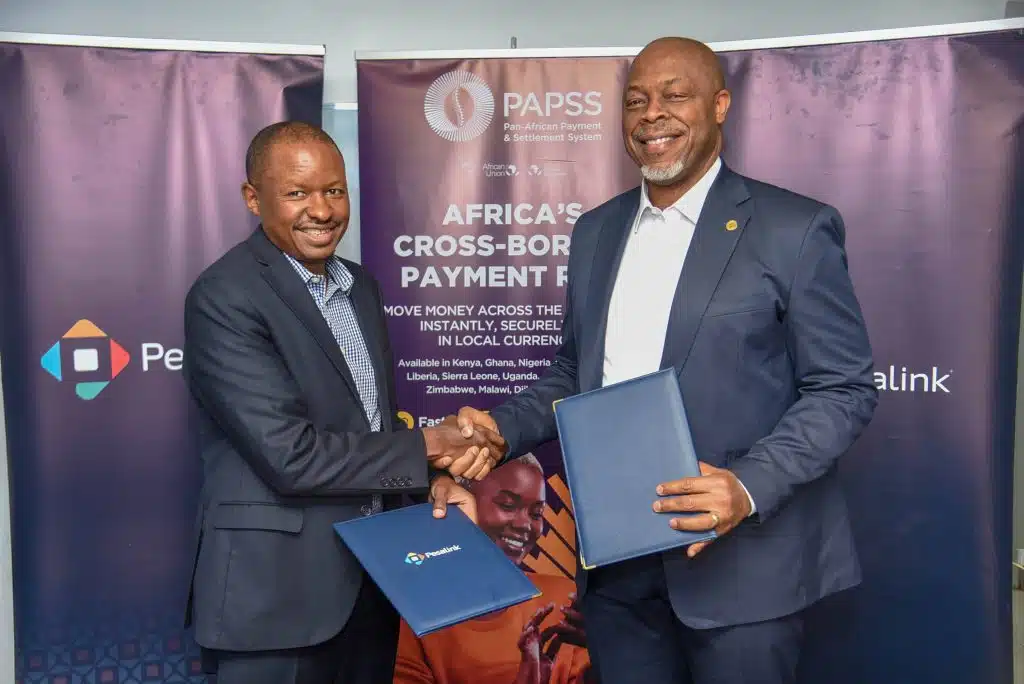
The latest integration with Pesalink illustrates this dynamic clearly. In late February, 2026, Pesalink, Kenya’s instant payment network, announced a partnership with the Pan-African Payment and Settlement System (PAPSS). Set to simplify cross-border payments, the partnership allows Kenyans to transact across the continent without needing foreign exchange.
Operated by the Kenya Bankers Association, Pesalink allows instant bank-to-bank transfers within Kenya. It links commercial banks, microfinance institutions, and other financial providers across the country.
By connecting Pesalink to PAPSS, the network of Kenyan financial institutions that use the system can now potentially reach banks across the continental payment platform without relying on traditional correspondent banking channels.
This matters for scale.
PAPSS currently links financial institutions across multiple African countries. Yet adoption depends largely on how easily domestic banks and financial service providers can plug into the system. When national switches like Pesalink integrate with PAPSS, they effectively open the door for dozens of institutions at once.
The Kenyan network connects more than 80 banks, fintech companies, SACCOs (Savings and Credit Cooperative Organizations), and telecom operators. Linking that ecosystem to the continental platform significantly expands the practical reach of PAPSS.
Payments professionals say the architecture behind the integration may be as important as the speed gains it promises. Fintech analyst and PAPPS Ambassador, Joshua Chukwu, described the partnership as “the blueprint for how Africa will connect,” arguing that linking national real-time switches with continental settlement platforms could accelerate financial integration across the continent.
Finally, it demonstrates how the broader architecture of African payment integration may evolve. Rather than replacing domestic systems, PAPSS works best when it sits on top of them.
Kenya’s advantage in digital finance
Kenya is particularly well-positioned to play this role.
Over the past two decades, the country has built one of Africa’s most sophisticated digital payment ecosystems. Mobile money, digital banking, and real-time transfers are widely used by individuals and businesses alike.
While mobile money platforms such as M-Pesa helped drive that transformation, bank-based infrastructure has also expanded rapidly. Systems like Pesalink enable instant bank transfers around the clock, reducing dependence on slower traditional clearing systems.
That maturity makes Kenya a natural environment for testing PAPPS’ ambition for African cross-border payment integration.
For Kenyan businesses trading across Africa, faster payment settlement could improve cash flow and reduce transaction costs. Small and medium-sized enterprises, which often struggle with delays in international transfers, may see some of the biggest benefits.
A trader importing goods from Tanzania or Ghana, for example, could theoretically complete payments in minutes rather than waiting days for funds to clear through multiple intermediary banks.
For banks and fintech firms, the integration could also open opportunities to build new cross-border services.
Broader implications for Africa
The Pesalink integration is unlikely to transform Africa’s payment landscape overnight. Building a fully connected continental system will take time, and participation across countries remains uneven.
Yet the development highlights an important lesson for policymakers and financial institutions across the continent.
Continental ambitions require domestic foundations.
As more countries build or upgrade national instant payment systems, connecting those systems to platforms like PAPSS could gradually create a network effect. Each new integration expands the reach of the entire ecosystem.
In that sense, the future of African cross-border payments may depend less on a single continental platform than on the growing web of domestic systems feeding into it.
Kenya’s experience could offer a model.
By linking an established national payment switch with PAPSS, the country is showing how local financial infrastructure can support broader regional integration. If similar connections emerge in other major financial markets across Africa, the continent’s payment architecture could begin to shift in meaningful ways.
For now, the Pesalink partnership represents one more step toward that vision.
It may not be the most visible development in African finance. But the quiet work of linking payment systems, country by country, network by network, could ultimately determine whether Africa’s long-promised financial integration becomes a reality.