

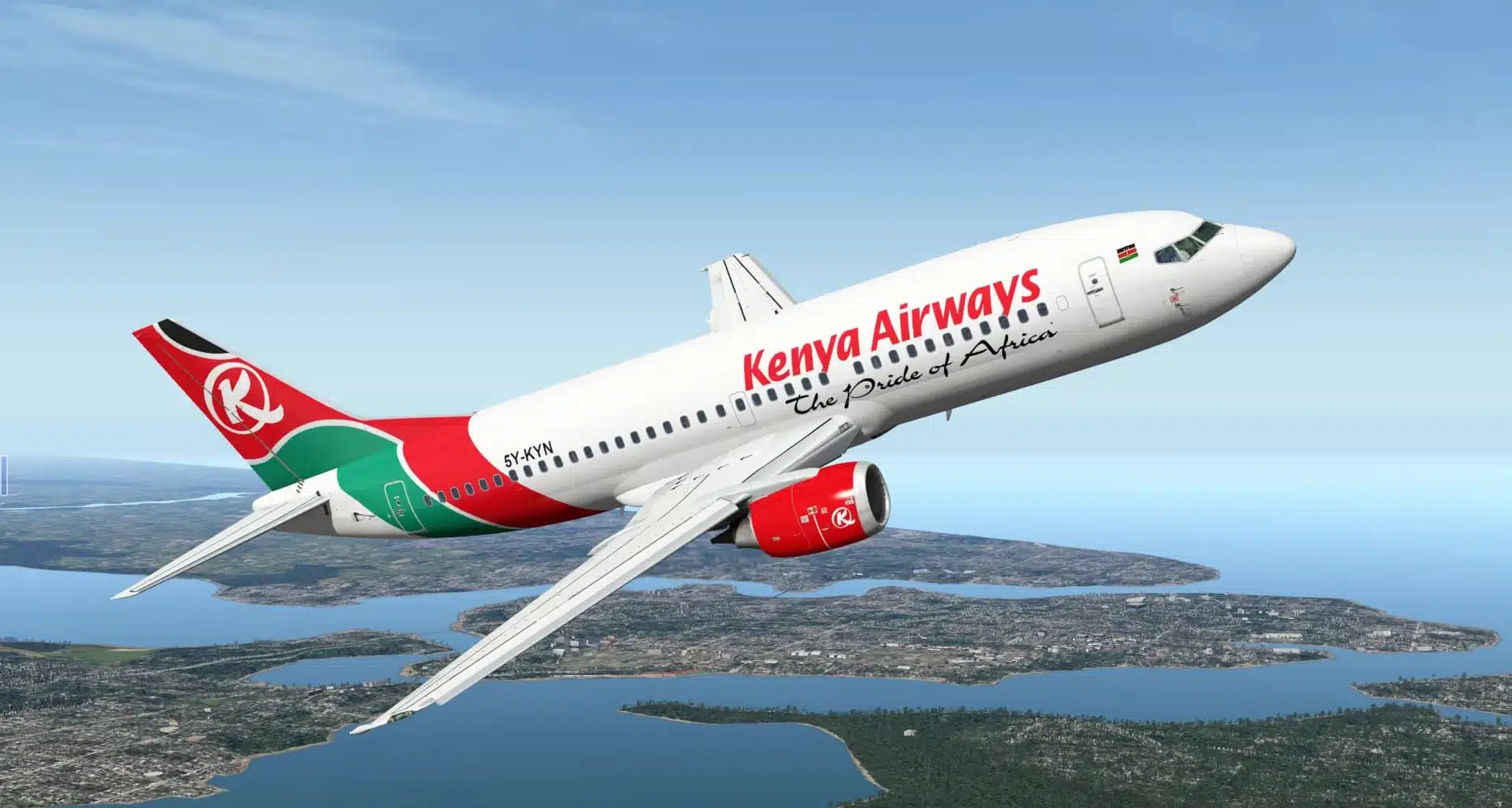


The national carrier’s full-year results, released on March 24, 2026, mark a sharp reversal from the modest profitability achieved in 2024 and underscore persistent operational and financial headwinds in African aviation.
Total revenue fell to $1.25 billion (KSh 161.5 billion) from $1.46 billion (KSh 188.5 billion) the prior year, a 14 per cent contraction. Management attributed the drop primarily to an 18 per cent reduction in available seat capacity after several aircraft, including Dreamliners, were grounded for maintenance and technical issues.
Passenger numbers and cargo volumes both declined, with no offsetting yield gains reported. Operating costs eased only modestly to $1.29 billion (KSh 167.1 billion), insufficient to prevent an operating loss of $43.2 million (KSh 5.6 billion), swinging from an operating profit of roughly $128 million (KSh 16.6 billion) in 2024.
High finance costs amplify the bottom-line hit
Net finance expenses of $95.1 million (KSh 12.3 billion), largely forex-related and interest on legacy debt turned the operating shortfall into a pre-tax loss of approximately $138.3 million (KSh 17.9 billion). After a modest tax credit, the group posted a net loss after tax of $132.7 million (KSh 17.2 billion), erasing the $41.7 million (KSh 5.4 billion) profit recorded in 2024 and pushing the net margin from +2.9 percent to –10.6 percent.
The rapid swing highlights how thin the airline’s margin of safety remains: even a single year of black ink proved unsustainable once capacity and currency pressures re-emerged.
Chronic losses since 2010 exceed $1.5 billion cumulatively
An accompanying performance chart reveals the depth of the problem. Kenya Airways has recorded net losses in 13 of the past 16 years. Major deficits include $279 million (KSh 36.2 billion) in 2020, $296 million (KSh 38.3 billion) in 2022 and $175 million (KSh 22.7 billion) in 2023. Cumulative losses since 2010 now surpass $1.54 billion (KSh 200 billion). The brief profits in 2010–2012 and 2024 appear as outliers rather than the start of a sustainable turnaround.
Despite partial privatisation (with the Kenyan government retaining a controlling stake and KLM holding a minority position), the carrier has repeatedly required taxpayer-backed support. High leverage, exposure to volatile jet-fuel prices, and reliance on foreign-currency debt continue to magnify external shocks.
Outlook and strategic implications
Kenya Airways has signalled plans to restore capacity by adding an extra aircraft to the lucrative London Heathrow route from July 2026. Yet without deeper cost restructuring, fleet modernisation, and a reduction in finance burdens, the numbers suggest another year of losses remains the base case. For investors and regional aviation watchers, the 2025 results serve as a reminder that one-off profitability is no substitute for structural resilience in a capital-intensive industry prone to capacity shocks and currency volatility.