


While global financial centres contend with subdued growth and elevated interest rates, Africa’s capital markets have entered 2026 with notable momentum, driven by strong equity performance, expanding investor participation and a steady push toward continental integration.
Across key exchanges, returns have outpaced broader economic growth;
- Sub-Saharan Africa’s GDP is projected at roughly 4.0–4.2% in 2026, reflecting steady but moderate regional expansion.
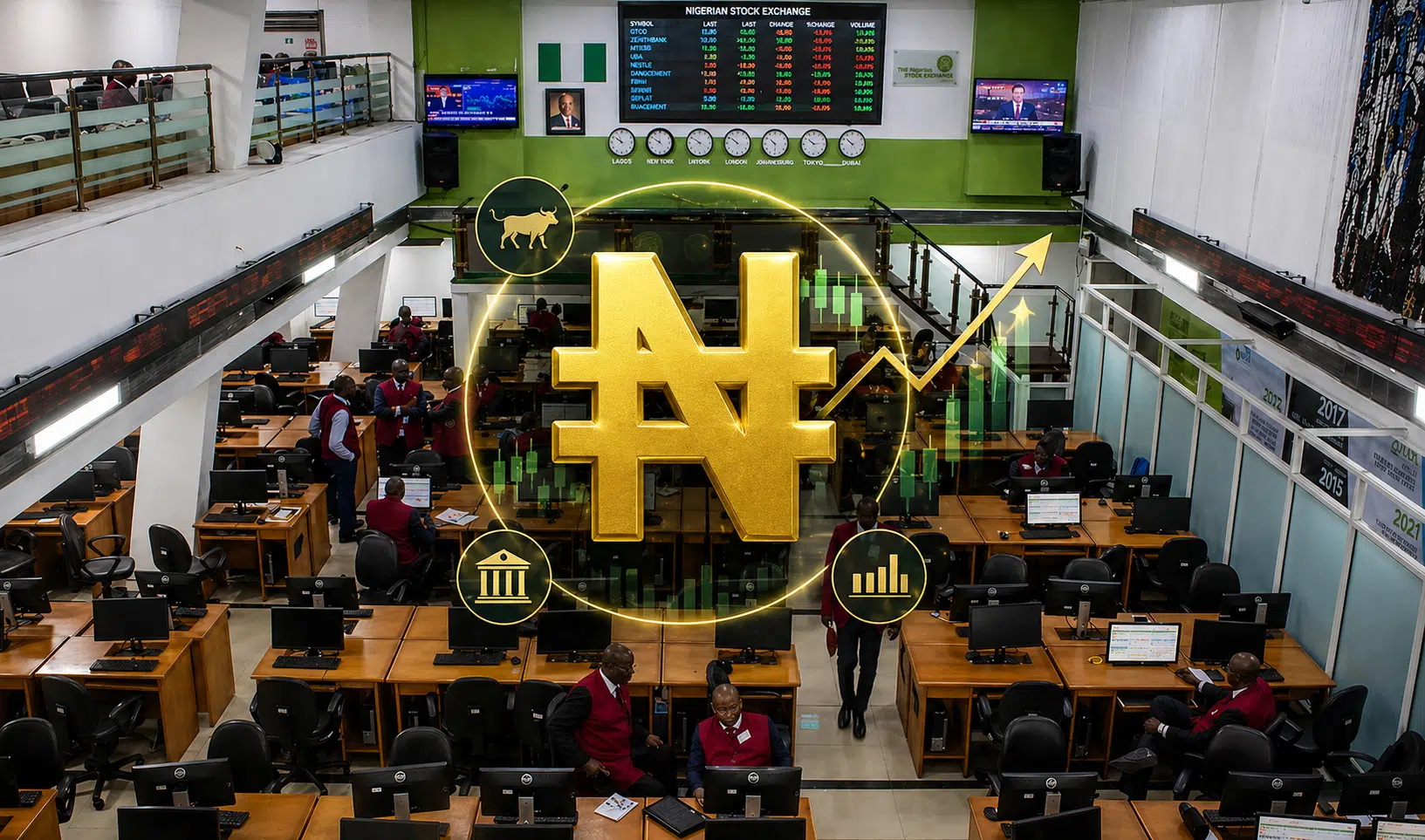
- The Nigerian Exchange Limited (NGX) has extended its multi-year rally, with the All-Share Index approaching the 200,000-point mark after gaining over 45% in 2023 and sustaining momentum through 2025. Total market capitalisation now stands at approximately $75–$80 billion, based on exchange data.
- The South African equity market (JSE) has recorded strong double-digit gains of roughly 30%–35% over the past year, supported by robust performance in financials, miners, and resource-linked stocks, alongside sustained strength in the broader market index.
- The Nairobi Securities Exchange (NSE) has posted strong double-digit gains in recent trading periods, driven by improved sentiment and performance in banking, telecommunications, and large-cap consumer stocks.
Although this momentum has strengthened bullish sentiment among market participants, these gains remain tempered by currency volatility, which continues to shape real investor returns. Nigeria’s naira has depreciated sharply since the 2023 FX reforms, losing over half its value against the US dollar, while Egypt’s pound has also gone through repeated devaluations. As a result, equity gains of 30–40% in local currency terms often translate into much lower, or even negative, returns in dollar terms.
Liquidity and capital depth remain key constraints
Across Africa’s capital markets in 2026, one contradiction keeps reappearing. Markets are expanding in size faster than they are deepening in liquidity.
Nigeria illustrates this clearly. Recent data shows the capital market added over $43.9 billion in value within 20 months, rising from about $35 billion to over $78 billion, while its contribution to GDP climbed from 13% to 33% over the same period. On the surface, this suggests rapid financial deepening. In practice, however, trading activity has not kept pace with valuation growth. Liquidity remains limited.
Take the Nigerian Exchange Limited for example, average daily turnover typically ranges between $10–$20 million. For a market approaching $80 billion in capitalisation, this level of activity is relatively low. More importantly, it is unevenly distributed.
Trading is heavily concentrated in a narrow group of large-cap stocks, including Dangote Cement, MTN Nigeria, Guaranty Trust Holding Company, Zenith Bank, Access Holdings, and Seplat Energy.
These stocks account for a substantial share of daily volume and value traded, forming the core of executable liquidity in the market. Outside this tier, trading activity drops off sharply. Many mid- and small-cap stocks experience low turnover, wide bid-ask spreads, and thin order books, making it difficult to execute large transactions without affecting prices.
This creates a structural imbalance. Investors can enter large-cap positions with relative ease, but exiting positions in less active stocks often requires price concessions, increasing transaction costs and weakening price discovery. In effect, liquidity exists, but only in concentrated pockets.
Nigeria’s experience reflects a broader continental pattern. On the Johannesburg Stock Exchange, daily trading value frequently reaches $800 million to over $1 billion, supported by a deeper institutional base. Yet even there, liquidity remains concentrated in a limited set of large, globally integrated companies, with thinner trading across the wider market.
The scale of the liquidity gap becomes clearer when measured against market size. Nigeria’s equity market generates a daily turnover ratio of roughly 0.01% to 0.03%. In comparison, South Africa records about 0.08%–0.1%, India about 0.3%–0.5%, and the United States roughly 0.4%–0.6%.
What emerges from these figures is a market structure that is not only smaller in scale but also thinner in liquidity relative to its size. Capital enters faster than it circulates, making prices more sensitive to relatively small flows and increasing volatility during periods of stress.
As SEC Director-General, Emomotimi Agama, has noted, “a market must be more than large, it must also be liquid”. Without broader participation and deeper trading activity, rising market capitalisation does not automatically translate into functional market depth.
This is where continental integration becomes more than a policy idea.
Structural reforms needed to unlock liquidity depth
Addressing Africa’s liquidity constraints will require more than continued market expansion. Market data and regulatory commentary suggest that liquidity improves only when participation broadens and trading becomes continuous across a wider set of securities.
In Nigeria, activity on the Nigerian Exchange Limited remains concentrated in a narrow group of large-cap stocks, limiting depth across the broader market. The SEC Director–General, has also warned that this concentration weakens price discovery and makes it harder for investors to exit positions efficiently.
Expanding institutional participation is therefore critical. In more liquid markets, pension funds and asset managers provide steady flows across sectors and market segments, rather than concentrating capital in a handful of names. The scale of activity on the New York Stock Exchange and Nasdaq reflects this depth, with liquidity supported by a broad and active investor base.
Market structure also plays a defining role. In markets such as India, trading activity on the National Stock Exchange of India is supported by market makers and a developed derivatives ecosystem, which helps sustain continuous trading and improves liquidity in underlying equities. Similar frameworks remain limited across many African exchanges, where trading still depends largely on matching natural buyers and sellers.
The African Exchanges Linkage Project is designed to address this fragmentation precisely by connecting multiple exchanges into a shared trading network. In theory, an investor in Lagos could access deeper liquidity pools in Johannesburg or Cairo without relying on offshore intermediaries.
Jude Chiemeka, Chief Executive Officer, Nigerian Exchange Limited, frames this as a structural turning point in an interview with Finance in Africa. “If you are interested in a sector and cannot find the right names locally”, He stated, “You can now look across other African markets. That improves liquidity and access.”
While the infrastructure is in place, differences in regulation, settlement systems and capital controls continue to limit its full impact.
Currency stability remains another key factor. Episodes of exchange rate volatility have historically reduced foreign portfolio inflows, as investors weigh currency risk alongside equity returns. This continues to affect overall market liquidity, even during periods of strong local performance.
Taken together, these factors point to a clear conclusion. Liquidity in African markets will not deepen through growth alone. It will depend on broader participation, stronger market structures, and a more stable macroeconomic environment.